Bhaktapur
Bhaktapur is an old Newar royal city about 13 km east of Kathmandu, with three great squares, brick lanes and carved wooden windows. Rickshaws, tuk-tuks and taxis are not allowed in the old city, so it is a lovely place to wander on foot, and it is famous for its pottery, its king curd and its New Year festival.

Altitude: 1,401 m
Getting there
Buses take about 40–60 minutes: minibuses and big buses leave from the stop near Bhadrakali, and an express bus from Bag Bazar. Wikivoyage says foreigners usually pay about NPR 50 and that you pay when you get off, so please agree the fare before boarding. A taxi from Thamel costs about NPR 1,000 one way according to Wikivoyage's Bhaktapur page, or around NPR 1,500 according to its Kathmandu page. Buses and taxis back wait just outside the first main gate.
Sites and entry fees
Fees are per person, in Nepali rupees, as published by the bodies that collect them.
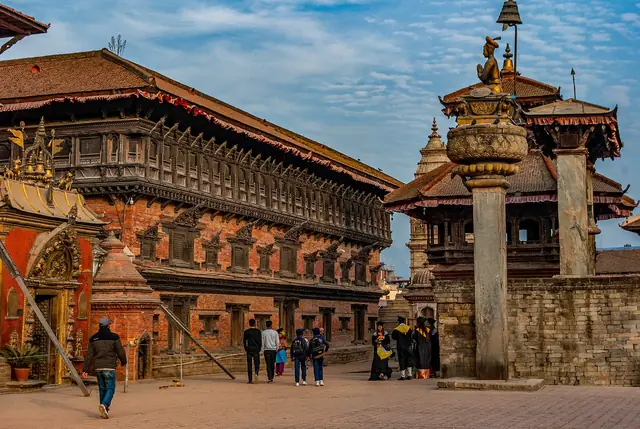
- Bhaktapur heritage area and Durbar Square: NPR 2,000 (SAARC nationals: NPR 500). The old royal square, seat of the Malla kings until 1769, with the Palace of Fifty-five Windows, completed in 1708, and the gilded Golden Gate of the 1750s leading to the Taleju shrine. The NPR 2,000 ticket (July 2025) covers the whole old city.
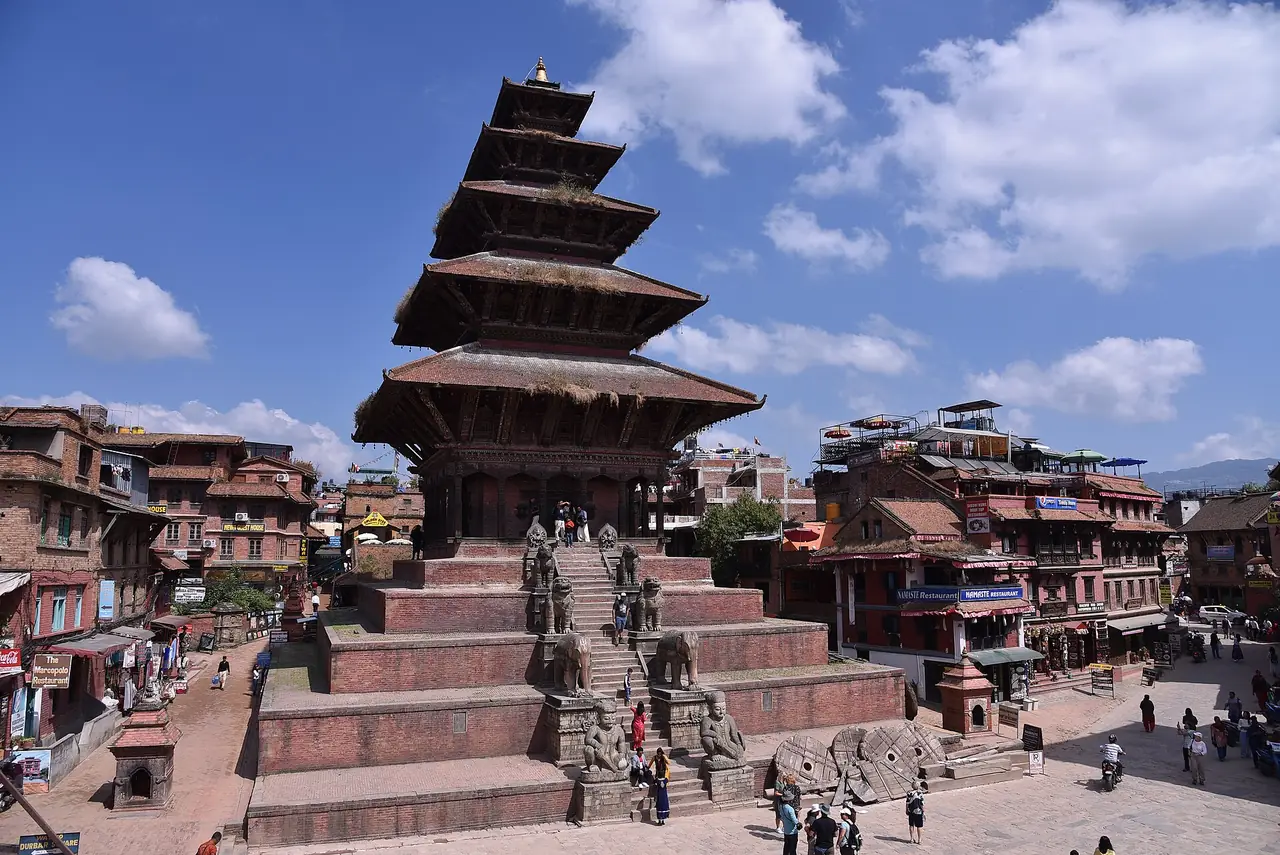
- Taumadhi Square and Nyatapola: No fee found. The square of Nyatapola, a five-roofed temple to the goddess Siddhi Lakshmi completed in 1702 and said to be the tallest temple in Nepal. Covered by the city ticket; only priests may go inside.
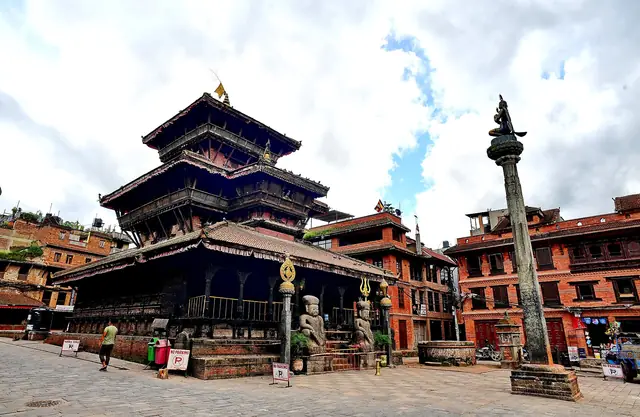
- Dattatreya Square and the Peacock Window: No fee found. One of the oldest parts of town, around a temple to Dattatreya from the reign of King Yaksha Malla (1428–1482). The famous Peacock Window of 1750 is beside the Wood Carving Museum. Covered by the city ticket.
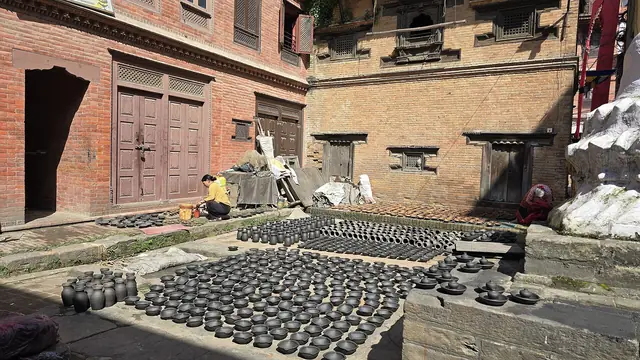
- Pottery Square: No fee found. A working square where clay pots are shaped and fired in the nearby alleys and set out to dry. Covered by the city ticket.
Fees change; check the official source before you go. Fees and rules checked on 2026-11-02.
Photos



Know before you go
The ticket is for the whole heritage area, not just Durbar Square, and is sold at the main entrances or at the Durbar Square gate. If you would like to come back on another day, ask at the counter for a note on your ticket so it covers the city for up to a week, as Wikivoyage describes. It is worth carrying your passport in case the counter asks for it. Locals still ride motorbikes in the narrow lanes, so keep to the side. Walk clockwise around shrines and take your shoes off in temple buildings.
What you'll see
- Durbar Square holds the Palace of Fifty-five Windows, completed in 1708 for King Bhupatindra Malla, and the Golden Gate, built between 1751 and 1754, which leads into the courtyards of the Taleju shrine.
- In Taumadhi Square, Nyatapola rises on five plinths, each with a pair of stone guardians: wrestlers at the bottom, then elephants, lions, griffins and two goddesses, each said to be ten times stronger than the pair below. The Bhairavnath Temple stands beside it.
- Dattatreya Square has the Dattatreya Temple and, beside the Wood Carving Museum, the Peacock Window, the best-known carved window in Bhaktapur.
- In Pottery Square you can watch potters at work and see rows of pots drying in the sun.
- Down by the river, Hanumanghat has lingams and cremation ghats; please be discreet there.
A walk around
- Enter by a main gate, buy your ticket, and start in Durbar Square with the palace, the Golden Gate and the big Taleju Bell.
- Walk on to Taumadhi Square for Nyatapola, then follow the lanes to Pottery Square.
- Finish at Dattatreya Square and the Peacock Window, one of the oldest corners of the city.
- Wikivoyage notes that the Siddha and Guhya Pokhari ponds are about 10 minutes west of the city along Nagarkot Road if you would like a quieter stretch.
- Nyatapola's stairway climbs five plinths, and the old town is seen entirely on foot, since vehicles for visitors are not allowed, so comfortable shoes help.
A little history
- Bhaktapur was a royal seat until 1769 and has been part of the Kathmandu Valley UNESCO World Heritage Site since 1979.
- The 1934 earthquake destroyed the palace's top floor and many courtyards; the city's restoration was later helped by the West German-funded Bhaktapur Development Project.
- The earthquake of 25 April 2015 damaged 116 heritage sites in Bhaktapur, 67 of them completely, including the Vatsala Durga temple and the domed Fasidega.
- Since then the municipality has completely rebuilt Vatsala Durga, and Fasidega was restored to its pre-1934 form, finished in 2022 according to Wikipedia. Nyatapola came through both great earthquakes standing.
- Your entry fee helps pay for these repairs: the municipality collected over NPR 290 million from it in 2024/25, The Rising Nepal reported.
- During the September 2025 protests, Hyperallergic reported that protesters stood outside the Bhaktapur World Heritage Site with signs asking for it to be protected; we found no report of damage to it.
Festivals
- Bisket Jatra (Biska Jatra) welcomes the Nepali New Year in mid-April. It follows the solar calendar, so it falls on 14 April, or 13 April in leap years.
- The god Bhairav is carried out in a huge chariot, and the upper and lower halves of the town pull it in a tug-of-war; the winning side takes the chariot into its area.
- A pole about 25 m tall, the yosin, is raised and then pulled down on the eve of the New Year.
- In nearby Bode, one man spends the day with an iron spike through his tongue, carrying flaming torches around the town.
- The tug-of-war draws big crowds into narrow streets, so please watch from the side and follow the lead of local people.
Eat and rest nearby
- Juju dhau, king curd, is the city's best-loved food: a rich yoghurt of buffalo or sometimes cow milk, set in clay pots.
- Look for samay baji, a Newari plate of beaten rice, marinated meat, lentils and pickles.
- Wikivoyage mentions bara, lentil patties, sold in an alley behind Nyatapola for about NPR 50, and small Newari eateries off Taumadhi Square best visited in the early afternoon.
- Tourist restaurants cluster around the main squares, and Wikivoyage notes they cost noticeably more than the small Newari eateries.
Combine it with
- Changu Narayan, a Vishnu temple about 6 km north believed to date to the 4th century, is a UNESCO World Heritage monument of its own and pairs naturally with Bhaktapur.
- The Surya Vinayak temple is about 2 km south of the city.
- Wikivoyage suggests Bhaktapur for a quiet first night, as it is closer to the airport than Thamel.
Sightseeing
- Kathmandu Valley: Three old royal cities, Kathmandu, Patan and Bhaktapur, and the temples and stupas around them. Seven of the valley's monument zones together form one UNESCO World Heritage Site, inscribed in 1979.
- Kathmandu Durbar Square: The old royal palace square of Kathmandu, also called Hanuman Dhoka or Basantapur, where Malla and Shah kings built palaces, temples and courtyards. It is one of the seven monument zones of the Kathmandu Valley World Heritage Site, inscribed in 1979, and much of it has been rebuilt since the 2015 earthquake.
- Patan (Lalitpur): Patan, also called Lalitpur, is the old Newar city just south of Kathmandu across the Bagmati River, known for centuries for its metalwork, wood carving and stone sculpture. Its royal Durbar Square, mostly from the 1600s, holds the Patan Museum and the stone Krishna Mandir, and the lanes around it are full of Buddhist courtyards and Hindu temples.
- Swayambhunath: A hilltop stupa just west of Kathmandu, ringed by shrines, monasteries and prayer wheels, and known to visitors as the Monkey Temple. It is one of the seven monument zones of the Kathmandu Valley World Heritage Site, and Buddhists and Hindus alike come here to pray.
- Boudhanath (Boudha): Boudhanath is one of the largest stupas in the world, 36 m high, in north-east Kathmandu and part of the valley's UNESCO World Heritage Site since 1979. Tibetan refugees settled around it after 1959, and more than 50 monasteries now stand in the lanes of Boudha, which feels like a small Tibetan town gathered round its great white dome.
- Pashupatinath: Nepal's most sacred Hindu temple, to Shiva as Lord of the Animals, on the banks of the Bagmati River in eastern Kathmandu. The wider holy area covers 246 hectares, with hundreds of small shrines, open-air cremation ghats, a wooded hill and the goddess temple of Guhyeshwari.
Sources disagree
- Bhaktapur entry fee, foreigners: NPR 2,000 (The Rising Nepal, 24 July 2025 (quoting the municipality)); NPR 1,800 (Wikivoyage — Bhaktapur; Nepal Tourism Board (undated))
- Taxi from Thamel to Bhaktapur, one way: about NPR 1,000 (Wikivoyage — Bhaktapur); around NPR 1,500 (Wikivoyage — Kathmandu)
- Distance from Kathmandu: about 13 km (Wikipedia — Bhaktapur); 16 km drive from Thamel (Wikivoyage — Bhaktapur)
- Nyatapola height: about 33 m (Wikipedia infobox); 30 m (Wikipedia article text)
- Who pays the SAARC rate: SAARC nationals and Chinese visitors pay NPR 500 (The Rising Nepal, July 2025; Wikivoyage); SAARC nationals only (Nepal Tourism Board table (undated))
Sources
- The Rising Nepal — Bhaktapur entry fees (24 July 2025)
- Wikivoyage — Bhaktapur
- Wikivoyage — Kathmandu (taxi fare to Bhaktapur)
- Wikipedia — Bhaktapur
- Wikipedia — Bhaktapur Durbar Square
- Wikipedia — Nyatapola
- Wikipedia — Biska Jatra
- Bhaktapur.com — Vatsala Durga Temple after the 2015 earthquake
- Hyperallergic — Historic Singha Durbar palace destroyed as Nepal protests turn deadly (10 September 2025)
- Nepal Tourism Board — Heritage site entry fees (undated)
Start here · Trekking · Sightseeing · Adventure · Pilgrimage
General guidance from the sources listed, not a guarantee. Rules, fees and trail conditions change; confirm with the official source or a registered trekking agency before you go.