Kathmandu Durbar Square
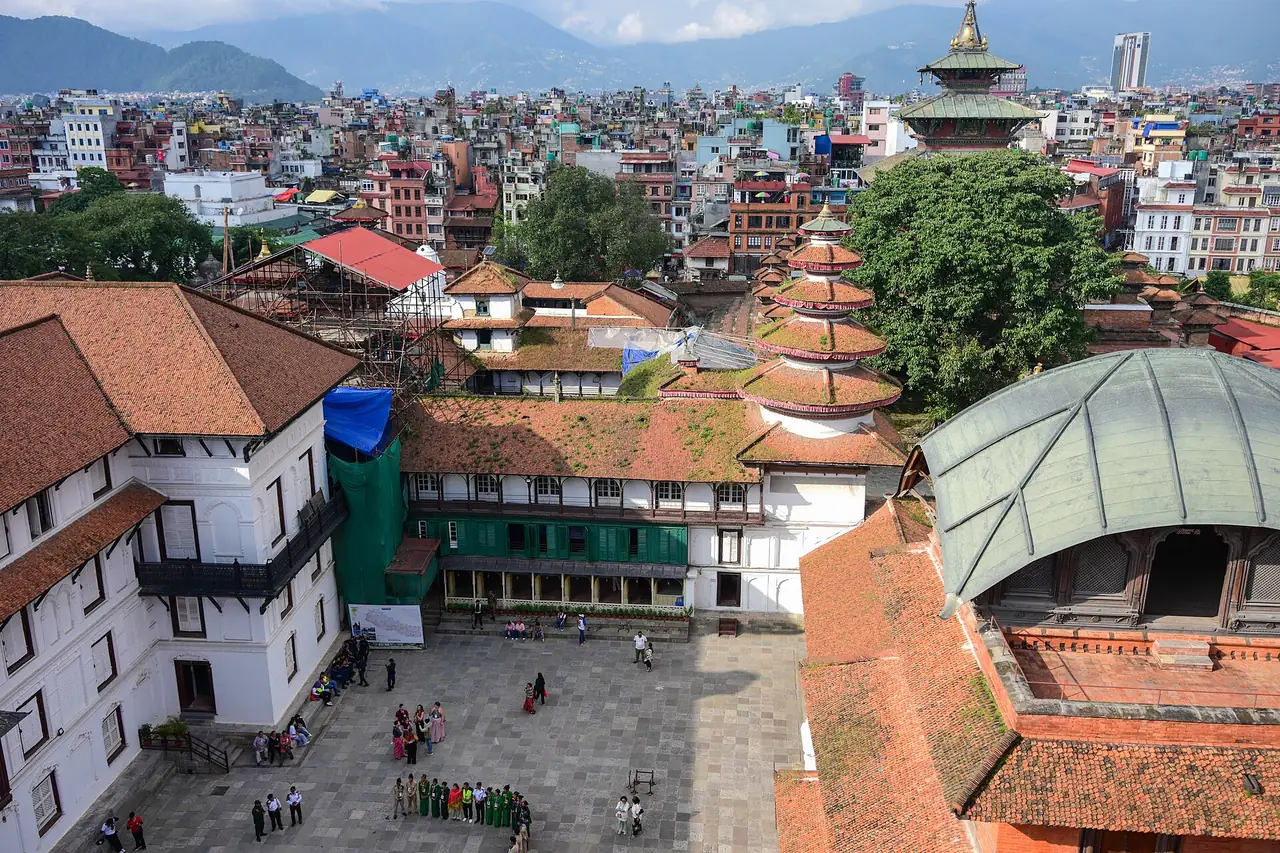
The old royal palace square of Kathmandu, also called Hanuman Dhoka or Basantapur, where Malla and Shah kings built palaces, temples and courtyards. It is one of the seven monument zones of the Kathmandu Valley World Heritage Site, inscribed in 1979, and much of it has been rebuilt since the 2015 earthquake.

Getting there
Most visitors walk from Thamel, and the old lanes of the centre are largely free of traffic. Wikivoyage suggests about 5–10 minutes by the main street, but the lovelier route goes through Indra Chowk and Asan, where you will want to linger. From Ratna Park, where many city buses stop, it is a short walk west.
Sites and entry fees
Fees are per person, in Nepali rupees, as published by the bodies that collect them.
- Kathmandu Durbar Square and Hanuman Dhoka palace (one ticket, museum included): NPR 1,000 (SAARC nationals: NPR 500). Foreigners pay NPR 1,000 and SAARC nationals NPR 500; the ticket covers the open parts of the square and the palace museums, including the Tribhuvan Museum. The palace takes its name from the Hanuman statue set up at its gate in 1672.
- Kumari Ghar (house of the living goddess): No fee found. Built in 1757 by King Jaya Prakash Malla, this is the home of the Kumari, a young girl worshipped as a living goddess; since 2025 she has been Aryatara Shakya. Visitors wait quietly in the courtyard for a brief glimpse at the carved window.
- Kasthamandap: No fee found. The great wooden rest house said to have given Kathmandu its name. It collapsed in the 2015 earthquake and was rebuilt by the community in traditional materials, reopening in April 2022.
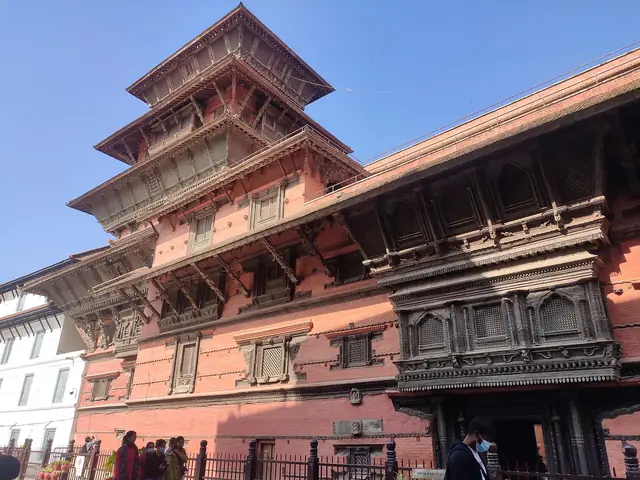
- Nine-storey Basantapur palace (Nautalle Durbar): No fee found. The nine-storey tower built by Prithvi Narayan Shah after the unification of Nepal. Restored with Chinese support after the earthquake, it reopened to the public in May 2025.
Fees change; check the official source before you go. Fees and rules checked on 2026-11-02.
Photos



Know before you go
Please keep your ticket with you, as it is checked inside the square; children under 10 go free. If you are staying a few days, Wikivoyage says the site office will turn your single ticket into a multiple-entry pass for free if you bring your passport and one passport photo. Young men may offer to guide you; a polite but firm no is fine if you'd rather explore alone. Please don't photograph the Kumari if she appears at her window, as it is strictly forbidden, though the courtyard itself is fine. A few buildings are still being rebuilt, so some courtyards may be closed when you visit.
What you'll see
- The Hanuman Dhoka palace is a cluster of courtyards; Nasal Chowk is where King Birendra was crowned in 1975, and Mohan Chowk, built in 1649, was the Malla kings' own residential courtyard.
- The palace museums tell the story of the Shah kings; the Gargahana gallery shows royal gold and silver jewellery found in a chest during excavation.
- The nine-storey Basantapur tower is one of four lookout towers Prithvi Narayan Shah added in 1768, each standing for one of the old cities of the valley.
- The Kumari Ghar, at the south of the square, is a three-storey Malla-era building with beautiful carved windows.
- Kasthamandap stands at the south-west corner, in Maru, and is the start of many festival processions.
A walk from Thamel
- Leave Thamel heading south through the lanes to Asan, an old bazaar square where six streets meet on the ancient trade route between India and Tibet.
- At Asan, look for the Annapurna Ajima temple, whose goddess watches over food and grain, and the stone fish at the centre of the square; stalls sell spices, textiles and much else.
- Walk on south-west to Indra Chowk, where the alleys are full of fabric shops and tailors, and then into the open space of Durbar Square.
- Wikivoyage recommends coming in the very early morning, when traders set up and local people make their offerings, and before the square fills up.
- Finish just south of the square on Freak Street, the old hippie-trail lane.
Rebuilding after 2015
- The earthquake of 25 April 2015 badly damaged the square, and Kasthamandap was among the buildings reduced to rubble.
- By January 2023, The Rising Nepal reported that 38 of 75 damaged temples had been repaired, including the nine-storey palace, Kasthamandap and the Taleju Temple, with 14 more under way.
- Kasthamandap reopened in April 2022 and the nine-storey palace in May 2025.
- Some work continues: in January 2025 the Department of Archaeology announced the rebuilding of Aagan Chhen, beside the entrance to Nasal Chowk, with Japanese help, so expect some scaffolding.
Festivals
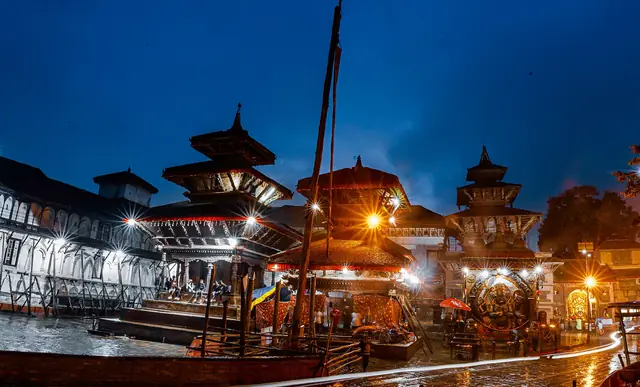
- Indra Jatra, usually in September, is the square's great festival: eight days of masked dances, music and processions, opening with the raising of a tall wooden pole, the yosin.
- During Indra Jatra the Kumari rides through the old city in a chariot, together with chariots for Ganesh and Bhairava, over three evenings; since 2012 an all-women team has pulled her chariot on the third day.
- The huge mask of Sweta Bhairava on the square is shown during Indra Jatra, when rice beer and alcohol flow from a pipe in its mouth on certain days.
- Asan is busy at its own festivals too, including Annapurna Jatra in October and the procession of Jana Baha Dyah (White Machhendranath) in April, which stops overnight there on its way to the square.
Freak Street
- Freak Street, properly Jhochhen Tol, is the small neighbourhood just south of the square.
- From the early 1960s to the late 1970s it was a famous stop on the hippie trail, when hashish was legal and sold openly; Nepal later banned it, and it is very much illegal today.
- Today it has guesthouses, trekking agencies, souvenir stalls and small places to eat, and it is calmer than Thamel; Wikivoyage says its guesthouses tend to cost less, though they look more tired.
Being a good guest
- The Kumari is a living goddess to many people here, so please stay quiet in her courtyard and keep your camera down if she appears.
- Walk clockwise around shrines, and take off your shoes before going into temple buildings.
- Wikivoyage notes you can climb the steps of some temples for a view; please sit lightly and leave room for people who come to worship.
- Watch out for counterfeit goods sold as antiques, and for plastic presented as wood, as Wikivoyage warns; buy for love, not as an investment.
Eat, rest and combine
- Freak Street, just south of the square, has a few small cafés and restaurants, and Wikivoyage says simple local Nepali eateries in the area charge around NPR 70–100.
- Thamel, about 1.4 km north, has the city's largest choice of places to eat.
- Swayambhunath is about 2.6 km west of Thamel and makes a good afternoon after a morning at the square.
- Patan Durbar Square, across the Bagmati River, is a fine second royal square for another day.
Sightseeing
- Kathmandu Valley: Three old royal cities, Kathmandu, Patan and Bhaktapur, and the temples and stupas around them. Seven of the valley's monument zones together form one UNESCO World Heritage Site, inscribed in 1979.
- Patan (Lalitpur): Patan, also called Lalitpur, is the old Newar city just south of Kathmandu across the Bagmati River, known for centuries for its metalwork, wood carving and stone sculpture. Its royal Durbar Square, mostly from the 1600s, holds the Patan Museum and the stone Krishna Mandir, and the lanes around it are full of Buddhist courtyards and Hindu temples.
- Bhaktapur: Bhaktapur is an old Newar royal city about 13 km east of Kathmandu, with three great squares, brick lanes and carved wooden windows. Rickshaws, tuk-tuks and taxis are not allowed in the old city, so it is a lovely place to wander on foot, and it is famous for its pottery, its king curd and its New Year festival.
- Swayambhunath: A hilltop stupa just west of Kathmandu, ringed by shrines, monasteries and prayer wheels, and known to visitors as the Monkey Temple. It is one of the seven monument zones of the Kathmandu Valley World Heritage Site, and Buddhists and Hindus alike come here to pray.
- Boudhanath (Boudha): Boudhanath is one of the largest stupas in the world, 36 m high, in north-east Kathmandu and part of the valley's UNESCO World Heritage Site since 1979. Tibetan refugees settled around it after 1959, and more than 50 monasteries now stand in the lanes of Boudha, which feels like a small Tibetan town gathered round its great white dome.
- Pashupatinath: Nepal's most sacred Hindu temple, to Shiva as Lord of the Animals, on the banks of the Bagmati River in eastern Kathmandu. The wider holy area covers 246 hectares, with hundreds of small shrines, open-air cremation ghats, a wooded hill and the goddess temple of Guhyeshwari.
Sources disagree
- How many structures the 2015 earthquake damaged in the square: 75 of the square's 96 structures (The Rising Nepal, 24 January 2023); 71 heritage sites (The Rising Nepal, 30 January 2025)
- Age of Kasthamandap: originally built in the 8th century (The Himalayan Times, 4 April 2022); a 16th-century pagoda-style temple (Wikivoyage — Kathmandu/West)
- When building on the square began: 3rd century (Wikipedia article text); 4th to 8th century (Wikipedia infobox)
- Walking time from Thamel: about 5–10 minutes via the main street (Wikivoyage — Kathmandu/West); Thamel is about 1.4 km north of the square (our existing Kathmandu guide (Wikivoyage/Wikipedia))
Sources
- Nepal Tourism Board — Heritage site entry fees (undated)
- The Himalayan Times (RSS) — Hanumandhoka Durbar Square collects Rs 194 million in revenue last year (5 September 2025)
- Wikipedia — Kathmandu Durbar Square
- Wikipedia — Hanuman Dhoka
- Wikipedia — Kumari (goddess)
- Wikipedia — Indra Jatra
- Wikipedia — Freak Street
- Wikipedia — Asan, Kathmandu
- Wikivoyage — Kathmandu/West
- Wikivoyage — Kathmandu
- Nepal Traveller — Kumari Ghar: Home of Nepal's Living Goddess (30 March 2025)
- The Himalayan Times — President Bhandari inaugurates reconstructed Kashthamandap temple (4 April 2022)
- Onlinekhabar — Historic nine-storey palace in Basantapur reopens to the public (21 May 2025)
- Onlinekhabar — Hanumandhoka opens new Gargahana museum (27 December 2020)
- The Rising Nepal — 38 of 75 Hanumandhoka temples rebuilt (24 January 2023)
- The Rising Nepal — DoA to reconstruct Aagan Chhen at Hanumandhoka (30 January 2025)
Start here · Trekking · Sightseeing · Adventure · Pilgrimage
General guidance from the sources listed, not a guarantee. Rules, fees and trail conditions change; confirm with the official source or a registered trekking agency before you go.