Pashupatinath
Nepal's most sacred Hindu temple, to Shiva as Lord of the Animals, on the banks of the Bagmati River in eastern Kathmandu. The wider holy area covers 246 hectares, with hundreds of small shrines, open-air cremation ghats, a wooded hill and the goddess temple of Guhyeshwari.

Getting there
The trust gives the taxi ride from Thamel as about 15 minutes; city bus routes 11, 22 and 30 also serve the temple at Gaushala. If you are coming from Boudhanath, Wikivoyage says it is about a 20-minute walk.
Sites and entry fees
Fees are per person, in Nepali rupees, as published by the bodies that collect them.
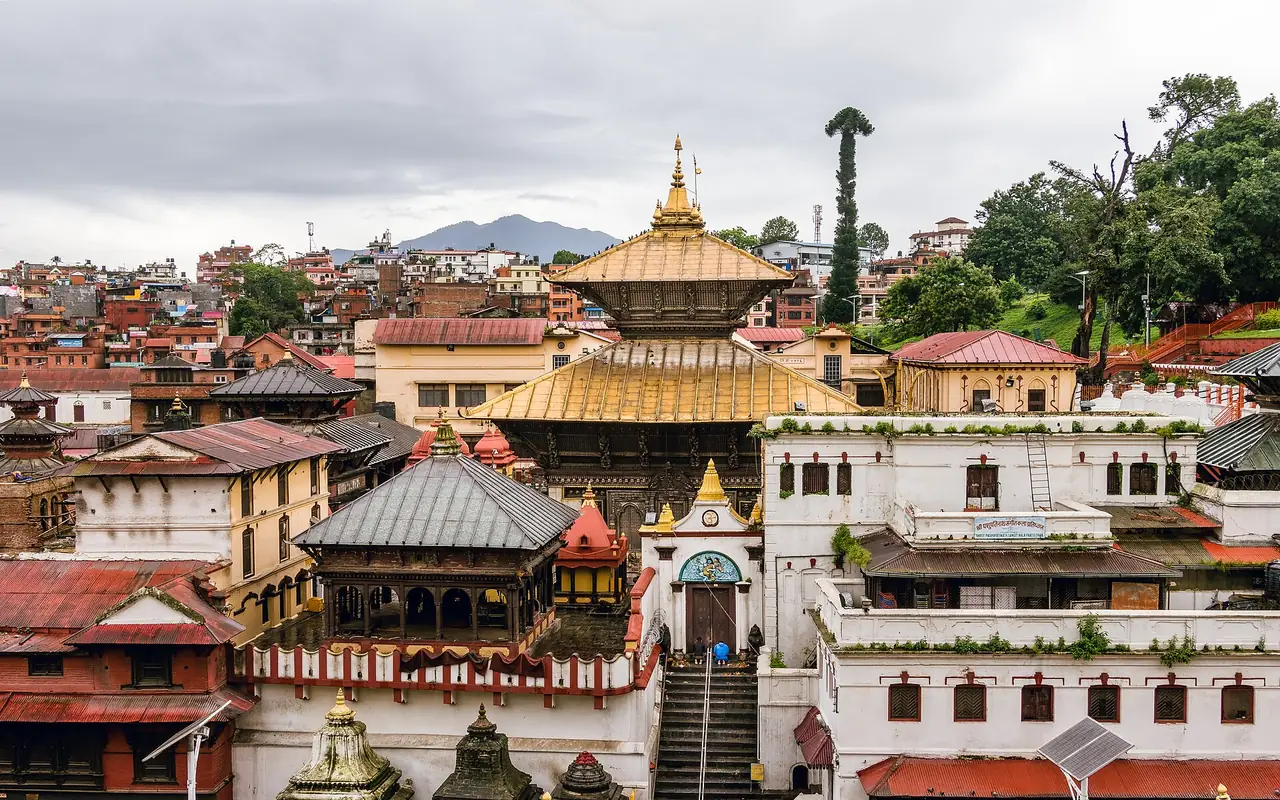
- Pashupatinath Temple and grounds: NPR 1,000 (Indian citizens: Free). Foreigners pay NPR 1,000 per day per entry, and SAARC nationals the same; Indian and Nepali nationals enter free. The temple is open 4 am to 9 pm; its two-tier golden roofs and silver-covered doors are visible from the grounds even if you cannot go in.
- Arya Ghat and the cremation ghats: No fee found. The best-known cremation ghat on the Bagmati, just by the temple; Bhasmeshwar Ghat, named for the sacred ash, is close by.
- Guhyeshwari Temple: No fee found. A goddess temple about 1 km east along the Bagmati, said to be one of the Shakti Peethas, where part of the goddess Sati's body fell. The trust calls it the area's most important temple after Pashupatinath itself; King Pratap Malla renovated it in the 17th century.
- Mrigasthali forest, Gorakhnath and Bishwarupa temples: No fee found. Across the river, a wooded hill holds the 18th-century Gorakhnath temple and the dome-shaped Bishwarupa temple, about 108 feet tall. Nearby, the hilltop Kirateshwar shrine holds a tall Shiva linga.
Fees change; check the official source before you go. Fees and rules checked on 2026-11-02.
Photos



Know before you go
Only Hindus may enter the main temple; everyone else is welcome on the ghats and can see the temple from the grounds and the far bank. Photography is not allowed inside the main sanctum, and is fine outside if done respectfully. The cremations are real funerals and a family's private grief, so please keep a respectful distance, stay quiet and put the camera away near a pyre. Some sadhus pose for photos and then ask for money, so please ask first and agree before you take a picture. Monkeys live all over the grounds; keep food out of sight.
What you'll see
- The main temple is a Newar-style pagoda with two gilded copper roofs, a golden pinnacle and four silver-covered doors, about 23 m tall; its present form dates from a 1692 renovation.
- Inside, out of sight for non-Hindus, is a one-metre stone linga with faces in several directions; only four priests may touch it.
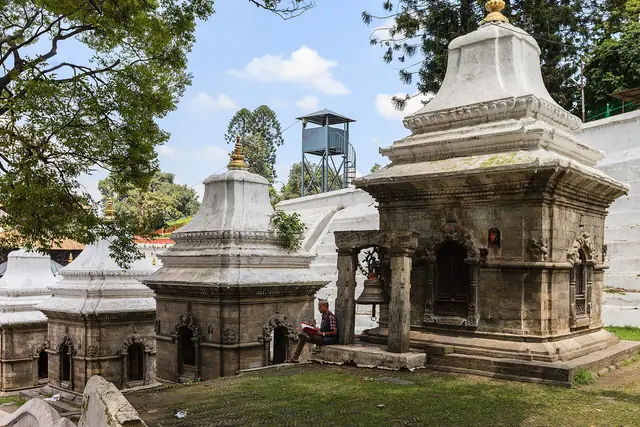
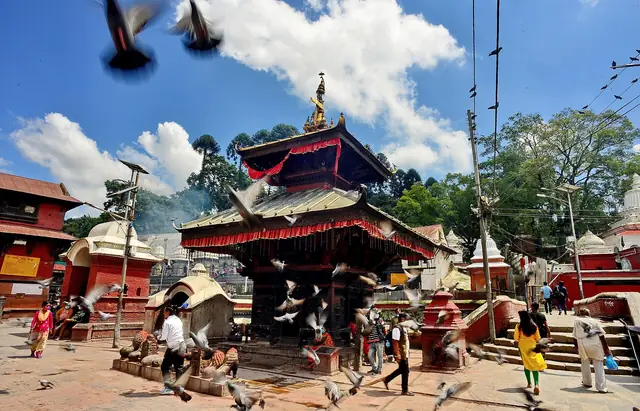
- Along the river are the cremation ghats, and around the grounds stand about 518 small temples and shrines.
- Climb through the trees of Mrigasthali on the far bank to the Gorakhnath and Bishwarupa temples, then follow the river east to Guhyeshwari.
- Buddhists hold the site sacred too: the cremation ground is counted among the eight great charnel grounds where Padmasambhava meditated.
The cremations
- Hindu families bring their dead to the ghats on the Bagmati for cremation in the open, and the trust runs the ghat services.
- It is a very moving sight, and a calm, quiet presence is the kindest thing you can offer.
- Please don't photograph grieving families or a body up close.
- The trust's own rules allow photography in the outer areas and at the ghats if it is done respectfully, so please let that word, respectfully, guide you.
Evening aarti
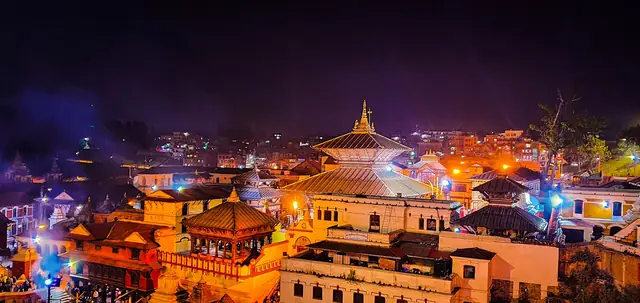
- Every evening priests offer an aarti of lamps, incense and song on the Bagmati, on the eastern side of the temple.
- The trust's website gives two different times, 6:30–7:30 pm in one place and 5–7 pm (with a night aarti at 7–8 pm) in another, so please check on the day.
- Come a little early for a place to sit or stand along the river, especially on festival days.
Festivals
- Maha Shivaratri, in February or March, is the temple's biggest night: in 2026 it fell on 15 February, and more than a million devotees were expected, with sadhus arriving from across Nepal and India.
- On Shivaratri expect very long queues and crowds from before dawn; it is a public holiday in Nepal, and if crowds trouble you it is wiser to come on another day.
- Haritalika Teej, in Bhadra (mid-August to mid-September), brings huge numbers of women, many in red, who fast and come to Pashupatinath to pray, mostly for their husbands' long lives.
- For big festivals the trust sets up separate queues by area; in 2022 it reopened the east entrance for Teej after it had been closed for about 15 years.
- Guhyeshwari has its own festivals and is very crowded during Navaratri and Dashain.
Sadhus and money
- Sadhus, Hindu holy men, sit around their fires near the temple, and the trust sets up a camp for them each Shivaratri.
- An Onlinekhabar writer at Shivaratri in 2018 saw sadhus pose for cameras and ask for money, with foreign visitors paying around NPR 50 a photo.
- Please ask before you photograph anyone and settle any donation first, so nobody feels cheated afterwards.
- Cannabis is still illegal in Nepal, even when it is offered around the sadhus' fires, so please politely decline.
Being a good guest
- Keep your ticket with you: it is per day and per entry, and there is a tourist ticket counter at the Tilganga side.
- Monkeys are many here, about 600 by the trust's estimate, and bites peak in July and August; if one bites or scratches you, please see a doctor the same day.
- The trust's office is open Monday to Friday, 9 am to 5 pm, on +977-01-4571828, if you have a question.
Combine it with
- Boudhanath, one of the largest stupas in the world, is about a 20-minute walk away; foreigners pay NPR 400 there.
- A good half-day plan is Pashupatinath in the afternoon, the aarti at dusk, then the lit-up stupa at Boudha, which Wikivoyage says is especially lovely at night.
- Wikivoyage notes that most cafés and restaurants around Boudha close by about 8 pm, so eat early if you stay for the aarti.
Sightseeing
- Kathmandu Valley: Three old royal cities, Kathmandu, Patan and Bhaktapur, and the temples and stupas around them. Seven of the valley's monument zones together form one UNESCO World Heritage Site, inscribed in 1979.
- Kathmandu Durbar Square: The old royal palace square of Kathmandu, also called Hanuman Dhoka or Basantapur, where Malla and Shah kings built palaces, temples and courtyards. It is one of the seven monument zones of the Kathmandu Valley World Heritage Site, inscribed in 1979, and much of it has been rebuilt since the 2015 earthquake.
- Patan (Lalitpur): Patan, also called Lalitpur, is the old Newar city just south of Kathmandu across the Bagmati River, known for centuries for its metalwork, wood carving and stone sculpture. Its royal Durbar Square, mostly from the 1600s, holds the Patan Museum and the stone Krishna Mandir, and the lanes around it are full of Buddhist courtyards and Hindu temples.
- Bhaktapur: Bhaktapur is an old Newar royal city about 13 km east of Kathmandu, with three great squares, brick lanes and carved wooden windows. Rickshaws, tuk-tuks and taxis are not allowed in the old city, so it is a lovely place to wander on foot, and it is famous for its pottery, its king curd and its New Year festival.
- Swayambhunath: A hilltop stupa just west of Kathmandu, ringed by shrines, monasteries and prayer wheels, and known to visitors as the Monkey Temple. It is one of the seven monument zones of the Kathmandu Valley World Heritage Site, and Buddhists and Hindus alike come here to pray.
- Boudhanath (Boudha): Boudhanath is one of the largest stupas in the world, 36 m high, in north-east Kathmandu and part of the valley's UNESCO World Heritage Site since 1979. Tibetan refugees settled around it after 1959, and more than 50 monasteries now stand in the lanes of Boudha, which feels like a small Tibetan town gathered round its great white dome.
Sources disagree
- Evening aarti time: 6:30–7:30 pm (Pashupati Area Development Trust, day schedule (pashupati.gov.np)); 5–7 pm evening aarti, then 7–8 pm night aarti (Pashupati Area Development Trust, darshan schedule (pashupati.gov.np)); from 7 pm (The Kathmandu Post, May 2017)
- Age of the temple: recorded as early as 400 CE (Wikipedia article text); 5th century CE (Wikipedia infobox)
- Maha Shivaratri 2026 crowd: over a million devotees expected (Spotlight Nepal, 15 February 2026); headline citing over 7 lakh (700,000) devotees in an earlier year (a reference title in Wikipedia — Pashupatinath Temple)
Sources
- Pashupati Area Development Trust — official site
- Pashupati Area Development Trust — Temples and monuments
- Nepal Tourism Board — Heritage site entry fees (undated)
- Wikipedia — Pashupatinath Temple
- Wikipedia — Guhyeshwari Temple
- Wikipedia — Teej
- Wikivoyage — Kathmandu/East
- The Kathmandu Post — Sandhya Aarati at Pashupatinath (28 May 2017)
- Spotlight Nepal — Maha Shivaratri 2026: more than a million expected at Pashupatinath (15 February 2026)
- Onlinekhabar — Shivaratri, Pashupatinath and babajis' shenanigans (13 February 2018)
- The Himalayan Times — East entrance of Pashupatinath Temple to be reopened after 15 years (29 August 2022)
- The Kathmandu Post — Alarming monkey bite, by Dr Sher Bahadur Pun (12 July 2023)
Start here · Trekking · Sightseeing · Adventure · Pilgrimage
General guidance from the sources listed, not a guarantee. Rules, fees and trail conditions change; confirm with the official source or a registered trekking agency before you go.