Bungee jumping in Nepal
Nepal has three working bungee sites: a 160 m bridge over the Bhote Koshi near the Tibet border, a 228 m bridge over the Kali Gandaki at Kushma, and a tower near Pokhara. Here is how each one works, what it costs, the rules since 2025, and how to jump with a calm, clear head.

Current notice: On 29 July 2026 Kantipur reported the Araniko Highway closed by landslides, and on 26 August 2026 a disastrous flood came down the Rasuwa Bhotekoshi and the Trishuli: the first reports counted 22 dead, and the toll later passed 1,400 (Wikipedia, citing government figures). That flood was not on the Last Resort's river, but please check the road and confirm your booking with the resort before you travel to the Bhote Koshi.
The essentials
- Three sites: Bhote Koshi (160 m, about 100 km from Kathmandu), Kushma (228 m, about 57–62 km from Pokhara) and Hemja near Pokhara (70–80 m tower).
- Since July 2025, national standards set jumpers' age at 16–70 and weight at 40–130 kg; each site may set tighter limits of its own.
- Heart disease, epilepsy, asthma, high blood pressure, recent surgery and pregnancy rule you out under those standards.
- Listed prices in 2026 run from about NPR 5,000 (Pokhara tower) to NPR 8,000 (Kushma) for the jump alone; day trips with transport cost more.
- Your own travel insurance should name bungee jumping and usually only pays out with a licensed operator and no alcohol.
- The roads matter as much as the jump: the Araniko Highway to the Bhote Koshi was blocked by landslides several times in 2025 and 2026.
Nepal's bungee sites at a glance
- The Bhote Koshi jump at The Last Resort, in Sindhupalchok, is Nepal's first bungee site. Its suspension bridge opened in 1999 and the jump is 160 m above the gorge (Kathmandu Post, 2018).
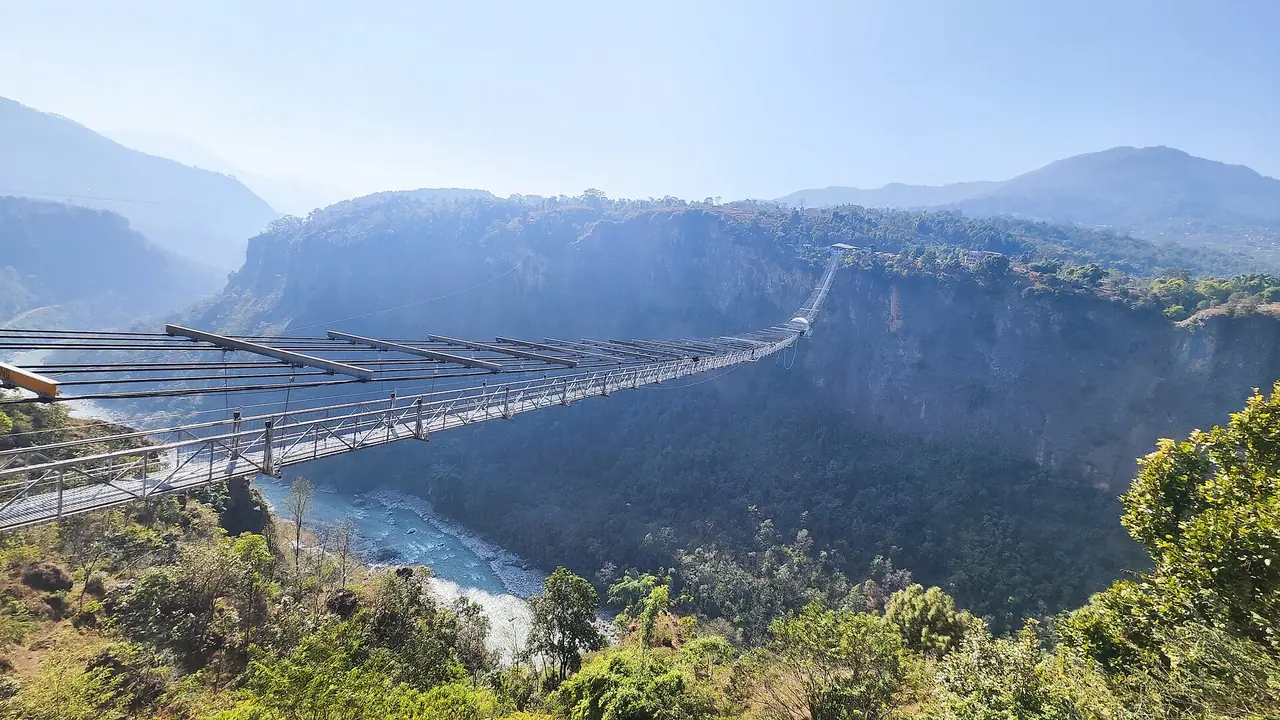
- The Kushma jump spans the Kali Gandaki between Kushma in Parbat and Balewa in Baglung. It has run since November 2020 and the bridge sits 228 m above the river (Kathmandu Post, 2026).
- The Pokhara jump is a steel tower in the Hemja valley, run by HighGround Adventures since September 2014. The 2014 Kathmandu Post report gave a 70 m drop; the company now lists an 80 m tower above a 50 m cliff.
- Each fixed site is run by one company, so we name them only to tell you which place is which, not as a recommendation.
- If you are short of time, the Pokhara tower is 20 minutes from Lakeside. Kushma is a half-day or overnight trip from Pokhara, and the Bhote Koshi is a long day from Kathmandu.
Bhote Koshi: The Last Resort (160 m)
- The resort sits on a cliff above the Bhote Koshi in Sindhupalchok, about 100 km east of Kathmandu, near the Tibetan border (Kathmandu Post, 2018). Kodari, at the border, is about 111 km from Kathmandu by road (Wikivoyage).
- The drive takes about three to four hours. In 2020 the resort's own bus left Thamel at 6am and took about three and a half hours with tea stops (Nepal Traveller).
- The bridge was Swiss-designed for bungee, with a safety factor of four and a 4.5-tonne capacity (Kathmandu Post, 2018). It was built by local workers and also links villagers to the main road (The Last Resort).
- Besides the bungee you can do a canyon swing, a tandem swing, canyoning and white-water rafting. The rafting runs about 15 km in about three hours and needs at least ten people, so solo guests join a group (The Last Resort FAQ).
- You can stay over in shared safari tents or bungalows; the resort has about 20 tents and 5 rooms, for up to 70 guests (Nepal Traveller, 2022). Wi-Fi is only in common areas.
- The 2015 earthquakes, landslides and floods badly hit the resort and the road, though business later picked up (Kathmandu Post, 2018).
Bhote Koshi prices, limits and booking
- The resort's FAQ gives weight limits of 40–98 kg for the bungee, 40–120 kg for the canyon swing and 40–140 kg for the tandem swing. That bungee limit is tighter than the national one, so the resort's figure is the one that applies.
- There is no fixed age limit at the resort, but anyone under 18 must come with a parent who signs the liability form (The Last Resort FAQ). The national standards say 16 is the minimum age.
- In 2018 the Kathmandu Post gave Rs 8,200 for foreigners and Rs 5,200 for Nepalis. In January 2020 Nepal Traveller listed US$108 for a bungee day trip with return transport from Kathmandu and a buffet lunch, and US$137 with the canyon swing too.
- We could not find a current price on the resort's own pages, so please ask for a written quote before paying. The resort asks for payment before the trip, by its website, bank deposit, or at its Thamel office at least three days ahead.
- Photos and video are a separate package: two videos, ten photos and a T-shirt for the bungee or canyon swing (The Last Resort FAQ).
- Sports or hiking shoes are compulsory, so please don't come in sandals.
Kushma: the Kali Gandaki bridge (228 m)
- The jump is from the middle of a 525 m suspension bridge, 228 m above the Kali Gandaki (Kathmandu Post, 2026). Other reports give 500 m or 520 m for the bridge.
- The operator, The Cliff Pvt Ltd, claims the world's second-highest bungee and the world's highest swing; rankings vary, so 'one of the world's highest' is fair. The site also has sky cycling, a mega-troll ride and a resort with rooms.
- There is room for about 50 jumps a day but around 300 people visit daily, so you may wait (Kathmandu Post, 2026). Kushma is on the Pokhara–Baglung Highway, about 57 km from Pokhara (Wikipedia); Buddha Air Holidays gives 62 km and about two hours by car.
- A booking site for the jump lists NPR 8,000 for a bungee or swing, the same for every nationality, valid to 15 December 2026; a second jump is NPR 4,000 and a fourth is free. A day trip with shared transport from Pokhara is NPR 10,800, or NPR 14,800 for both, and day trips don't run on Mondays.
- For an overnight stay its 'Stay & Play' package is NPR 13,500 a person with a jump. Buddha Air Holidays gives a weight range of 45–95 kg (128 kg combined for a couple's swing) and says staff may check your blood pressure.
- The national standards reported in July 2025 set a maximum of Rs 6,000 per jump, below the listed prices. We don't know how that cap is applied, so it is worth asking politely what the price covers and for a tax receipt.
Pokhara: the Hemja tower
- HighGround Adventures opened the tower jump on 22 September 2014; the Kathmandu Post called it Nepal's first bungee from a tower, with jumpers landing over an artificial pond and picked up by boat.
- Today the company lists an 80 m cantilevered tower above the Hemja valley and a 50 m cliff, with about five seconds of free fall. It is about 20 minutes from Lakeside.
- The company lists a standard jump from NPR 5,000 and a tandem jump at NPR 9,500, with pick-up from its Lakeside office, a briefing and the return transfer included (HighGround, checked November 2026). In 2014 the price was Rs 6,890 for foreigners.
- For the tandem jump it gives ages 12–65, weight 45–100 kg and height over 130 cm, with in-person parental consent for under-18s.
- You need closed shoes, modest clothing (no skirts or flip-flops) and photo ID whose name matches the card you pay with.
- The same company runs Pokhara's ZipFlyer, so you can do both in one day if you like.
New sites on the way
- A second Pokhara bungee is planned as part of an adventure park in Rato Pahiro (Pokhara-17) and Aminatara (Pokhara-15), costing about NPR 30 crore (Ratopati, March 2026).
- The plan includes a bungee, a swing bungee, a glass bridge and cliff climbing, but a project report was still being prepared and no opening date was given.
- The national standards say bungee sites must be at least 20 km apart, which may shape where new sites go.
- We found no new bungee site that opened in 2023–2026, and no confirmed site inside the Kathmandu Valley. If you see one advertised, please check it holds a Department of Tourism licence.
Rules and licensing
- In July 2025 the tourism ministry brought in the Adventure Sport Bungee Operation Standards, 2078, under the Tourism Act (The Himalayan Times). Operators must be licensed by the Department of Tourism.
- A licence lasts five years and needs a Rs 10 lakh bank guarantee to renew. Operators that break the standards can lose their licence.
- Jump masters must be licensed and have five years' experience. Harnesses, helmets and cords must carry international safety certification and be stored at a controlled temperature.
- Cords must be replaced after 500–700 jumps or six months, whichever comes first. That matters because a cord wears with use, even when it looks fine.
- Operators must insure both staff and jumpers, take a health declaration and emergency contact before each jump, and must not let anyone jump in bad weather or when drunk.
Safety record and why the checks matter
- In Nepali news coverage we found no reported deaths at Nepal's three bungee sites. That is reassuring, but it is not a guarantee, and small incidents may not be reported.
- Abroad, things have gone wrong. On 31 December 2011 a cord snapped at the Victoria Falls Bridge in Zambia; the jumper fell into the river and survived with a broken collarbone (Claims Journal). That is why cord replacement rules exist.
- Weight matters because the cord is matched to your body weight. In 2004 the Bhote Koshi staff weighed every jumper and wrote the weight on their hand (Nepali Times), and staff at all sites still weigh you.
- A health check is part of the process. In 2018 the Kathmandu Post reported a compulsory medical check for every customer at the Bhote Koshi.
- The road there is often the riskier part of the day. Nepali Times made the same point in 2004, and it still holds in the monsoon.
Health, and what to check on the day
- The 2025 standards bar people with heart disease, epilepsy, asthma, high blood pressure, recent surgery, pregnancy or artificial limbs. The jump puts a sudden, strong load on the heart, spine and joints, so with a back, neck or knee problem please ask your doctor first.
- Don't drink or take drugs or medicines that slow your judgement beforehand. The standards forbid it, and most insurance won't pay if you were intoxicated. Please be honest on the health form; it is how the crew keeps you safe.
- Ask to see the company's Department of Tourism licence and what its insurance covers for you. A good operator won't mind you asking.
- Watch for a proper briefing, a weight check and a look at the harness, helmet and cord before you are clipped in. It is fair to ask when the cord was last replaced.
- Staff should check every buckle and connection twice, and no one should hurry you. If the weather turns and jumps stop, please accept it; the rules forbid jumping in bad weather for good reason.
- Wear closed sports shoes and fitted clothes, and leave loose items in a locker or with a friend.
Insurance, seasons and roads
- Check that your travel insurance names bungee jumping. World Nomads, for example, covers it only with a licensed operator and not if you were drunk or if a pre-existing condition was involved.
- The UK government advises researching any company before booking and having cover for rescue and helicopter costs, which matters on remote roads.
- Buddha Air Holidays suggests autumn (September–November) or spring (March–May). The monsoon, roughly June to September, brings landslides that can close roads for days (UK FCDO).
- The Araniko Highway to the Bhote Koshi was closed by landslides on 19 June 2025, and again at Kodari on 23 July 2025, which also shut the Tatopani border crossing. The Iku area there has been high-risk since the 2015 earthquake (ShareSansar).
- The July 2025 'Bhotekoshi flood' was on a different river of the same name in Rasuwa, which damaged the Syaphrubesi–Rasuwagadhi road (Kathmandu Post). It was not on the Last Resort's river.
- Kushma is reached on the Pokhara–Baglung Highway, so in the monsoon please check that road is open before you set off.
Photos

Sources
- The Himalayan Times — Nepal introduces national standards for safe and systematic bungee jumping (3 July 2025)
- Kathmandu Post — A 228-metre leap above Nepal's Kaligandaki gorge (28 October 2026)
- ShareSansar — World's highest bungee and swing from bridge come into operation (4 November 2020)
- Kantipur (English) — Bungee's changed identity (20 March 2025)
- Kathmandu Post — Domestic tourists seek thrill of bungee jumping (11 May 2018)
- Nepali Times — Life in free fall (3 December 2004)
- Kathmandu Post — High Ground introduces bungy jumping in Pokhara (22 September 2014)
- Ratopati — Another bungee jump is being added to Pokhara (13 March 2026)
- The Last Resort — FAQ (checked November 2026)
- The Last Resort — Our story (checked November 2026)
- Nepal Traveller — The Last Resort bungee (5 January 2020)
- Nepal Traveller — The Last Resort: satiating your hunger for both adventure and peace (29 December 2022)
- Nepal Traveller — Bungee places in Nepal (28 March 2023)
- Kushma bungee booking site — price list (valid to 15 December 2026)
- Buddha Air Holidays — Kusma bungee package (checked November 2026)
- HighGround Adventures — Bungee Pokhara (checked November 2026)
- Wikipedia — Kusma, Parbat
- Wikipedia — Bhote Koshi
- Wikivoyage — Kodari
- ShareSansar — Landslide cuts off Araniko Highway, Tatopani border crossing closed (24 July 2025)
- Kantipur (English) — Araniko highway closed due to landslides (19 June 2025)
- Kantipur (English) — Landslides and floods affect major highways, five roads completely blocked (29 July 2026)
- Kathmandu Post — One-way traffic resumes on flood-hit Rasuwagadhi road after 13 days (21 July 2025)
- Kathmandu Post — What we know about the Bhotekoshi flood so far (26 August 2026)
- Claims Journal — Snapped bungee plunges tourist into African river (10 January 2012)
- World Nomads — Bungee jumping travel insurance (checked November 2026)
- UK FCDO — Nepal travel advice: safety and security
- Wikipedia — 2026 Nepal–Tibet floods
Fees and rules checked on 2026-11-02.
Getting to Nepal · Arriving at Kathmandu airport · Nepali words to know before you land · What's normal in Nepal, and might surprise you · Phones, SIM cards and internet in Nepal · Getting around Nepal · Money in Nepal · Staying safe in Nepal · What to pack for Nepal · Food and drink in Nepal · Kathmandu: where to stay, what to see and what to eat · Kathmandu after dark: where to hang out, eat, drink and dance · Paragliding in Nepal: Sarangkot, other sites and how to fly safely · Rafting and kayaking in Nepal · More adventure in Nepal: zipline, canyoning, mountain biking, climbing and more · Visiting Nepal's sacred sites: a pilgrim's guide
Start here · Trekking · Sightseeing · Adventure · Pilgrimage
General guidance from the sources listed, not a guarantee. Rules, fees and trail conditions change; confirm with the official source or a registered trekking agency before you go.