What's normal in Nepal, and might surprise you
Some everyday habits in Nepal would feel odd in Europe or North America, and some things that are normal at home can come across as rude here. None of it is hard to learn, and people are very forgiving of visitors who try. Here is what to expect, and the reason behind each custom.

The essentials
- Calling an older stranger aama (आमा, mother) or buwa (बुवा, father), or a shopkeeper dai (दाइ, older brother) or didi (दिदी, older sister), is warm and respectful, not strange.
- Questions about your age, job, marriage or what you paid are friendly curiosity, not prying.
- A gentle side-to-side tilt of the head usually means yes or OK, not no.
- Two male friends holding hands is ordinary friendship, while couples kissing in public is frowned upon.
- Give and receive with your right hand, and don't share food or drink that has touched your mouth (jutho).
- Take your shoes off in homes and temples, and walk clockwise around stupas.
Family words for people you have just met
- In English, calling a stranger 'Mum' or 'Dad' would be strange. In Nepal, older people are often called aama (आमा, mother) and buwa (बुवा, father), and it comes across as kind and respectful.
- Someone a little older than you is dai (दाइ, older brother) or didi (दिदी, older sister), and someone younger is bhai (भाइ, younger brother) or bahini (बहिनी, younger sister). People use these for waiters, drivers, shopkeepers and people on the trail, treating them like family.
- In cities, young people also call older people 'uncle' and 'auntie' in English, even with no family link. The Kathmandu Post has written about how this habit treats the whole of society as family.
- Calling an older person by their first name alone can sound too casual. Adding ji (जी), as in Ram ji, is polite, a little like 'Mr' or 'Ms'.
- Nepali has several levels of 'you'. Tapai (तपाईं) is polite and the safe choice for visitors, timi (तिमी) is for friends and children, and hajur (हजुर) is the most respectful.
Conversation
- On first meeting, people may ask how old you are, whether you are married, whether you have children, what you do and what things cost. It is friendly curiosity, and it also helps them know how to address you.
- Travellers on their own, especially women, may be asked kindly why they are alone, because many people rarely travel anywhere without family or friends.
- Khana khanubhayo? (खाना खानुभयो?), 'have you eaten?', is one of the most common greetings. It works like 'how are you?', and a simple 'yes, thank you' is fine.
- A gentle side-to-side tilt of the head usually means yes or OK. To Western eyes it can look like a no, so watch the face and the words together.
- A flat 'no' can feel harsh, so people often say 'maybe' or 'I'll try' instead, and a yes can mean 'I'm listening'. Gentle, open questions get clearer answers.
- As a visitor you may be looked at, approached or asked for a photo. Staring isn't considered rude in Nepal; it is usually simple curiosity.
- People often point with their chin rather than a finger. To say 'no thanks' to a seller, hold one hand up, palm out, with a small twist of the wrist.
Greetings, touch and the body
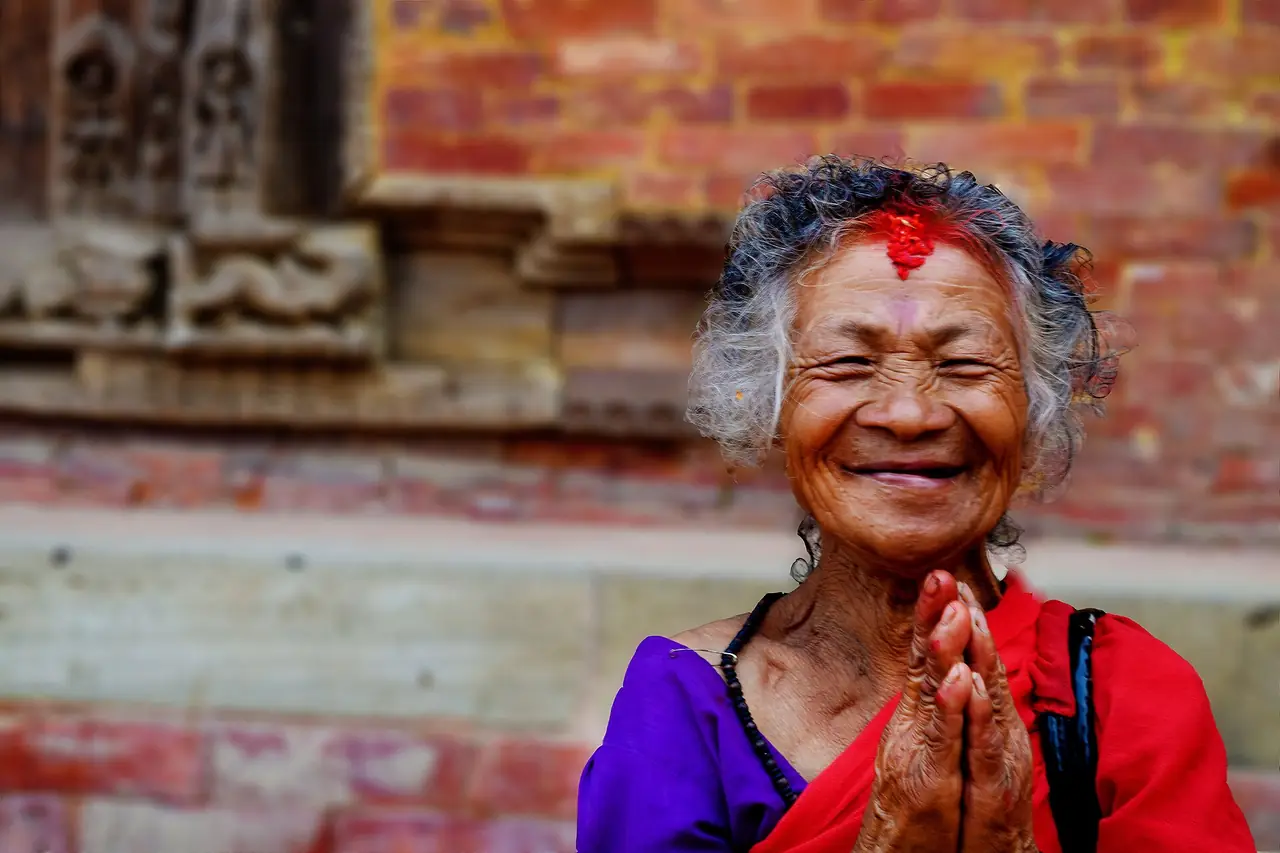
- Namaste (नमस्ते), with your palms pressed together, replaces the handshake and the hug for hello and goodbye. Namaskar (नमस्कार) is more formal, for older people. Hugs and kisses with people you don't know well are best avoided.
- Contact between men and women is more reserved. Men are best to wait and see whether a woman offers her hand first.
- Two men, or two women, holding hands or walking arm in arm is common. It shows friendship or family, not romance.
- Kissing or cuddling in public is widely seen as inappropriate, especially in villages and near temples, so couples keep affection for private.
- The head is seen as the purest part of the body, so don't touch anyone's head, even to pat a child, and don't playfully take someone's cap (topi, टोपी).
- Feet are the lowest part. Don't point the soles of your feet at people or shrines, step over someone's legs, touch people or books with your feet, or rest your feet on chairs and tables. If you bump someone with your foot, touch them and then your forehead as a quick apology.
- At Dashain, younger relatives bow to touch the feet of elders when they receive a blessing and tika (टीका), the red mark on the forehead. It is a sign of deep respect.
Hands, food and jutho
- The left hand is traditionally used for washing, so give, receive and pass things with your right hand, or with both hands to show extra respect.
- Many people eat dal bhat with the fingers of their right hand, and wash their hands before and after the meal. Do try it, but it's fine to ask for a spoon.
- Food or drink that has touched someone's mouth is jutho (जुठो), meaning impure. So don't offer someone a bite of your snack, share a spoon, or eat off another person's plate.
- From a shared bottle or jug, many people pour water into their mouth without the rim touching their lips. If that's tricky, just ask for a glass.
- Wait to be served rather than helping yourself, and don't serve from a shared dish with your own spoon. The kitchen and the fire are kept pure, so wait to be invited into a kitchen, and never throw rubbish into a fire.
- Atithi devo bhava (अतिथि देवो भव), 'the guest is God', is a guiding idea. Guests are often served first and given the best. Take a small first helping, because asking for more is the nicest compliment, and accept tea when it's offered, even if you only sip it.
- The cow is sacred to Hindus and is Nepal's national animal, so many Nepalis don't eat beef. Please don't offer it or bring it as a gift.
- A small gift of fruit or sweets is welcome. It may be put aside quietly rather than opened in front of you with big thanks; that isn't rudeness.
Temples, dress and photos
- Take your shoes off before entering homes, temples and shrines. A pile of shoes at the door is your cue.
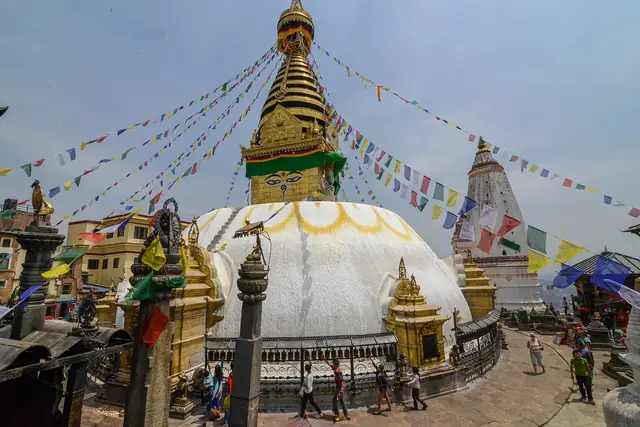
- Walk clockwise around stupas, prayer wheels and many temples, keeping the shrine on your right. This matters most at Buddhist stupas such as Boudhanath and Swayambhunath.
- Leather belts, bags and shoes aren't allowed inside some temples, because the cow is sacred.
- Some Hindu temples, or their inner shrines, are open only to Hindus. At Pashupatinath, everyone is welcome in the wider grounds and along the river, but the main temple is for Hindus only.
- Ask before you photograph people, ceremonies or sacred objects. At Pashupatinath, photos aren't allowed inside the temple or during ceremonies, and cremations are watched quietly, from a distance.
- Clothes that cover your shoulders and knees are appreciated, especially in villages and temples, and men usually wear a shirt in public. Pashupatinath asks visitors not to wear shorts or sleeveless tops.
Smaller things
- Leaving shoes or sandals upside down is considered bad luck in many homes, so turn them the right way up.
- Social plans often start later than the time given, and that's normal. Business meetings, flights and buses are a different matter.
- Handing sweets, pens or money to children in the street encourages begging. Giving through a school or a local charity helps more.
Photos

Sources
- Nepal Tourism Board — Cultural etiquette
- Wikivoyage — Nepal (Respect)
- Rough Guides — Culture and etiquette in Nepal
- The Cultural Atlas — Nepalese etiquette
- The Cultural Atlas — Nepalese greetings
- The Cultural Atlas — Nepalese communication
- The Kathmandu Post — Uncle and auntie
- Pashupati Area Development Trust — visitor rules
- Wikipedia — Nepali language (honorifics)
Fees and rules checked on 2026-11-02.
Getting to Nepal · Arriving at Kathmandu airport · Nepali words to know before you land · Phones, SIM cards and internet in Nepal · Getting around Nepal · Money in Nepal · Staying safe in Nepal · What to pack for Nepal · Food and drink in Nepal · Kathmandu: where to stay, what to see and what to eat · Kathmandu after dark: where to hang out, eat, drink and dance · Paragliding in Nepal: Sarangkot, other sites and how to fly safely · Bungee jumping in Nepal · Rafting and kayaking in Nepal · More adventure in Nepal: zipline, canyoning, mountain biking, climbing and more · Visiting Nepal's sacred sites: a pilgrim's guide
Start here · Trekking · Sightseeing · Adventure · Pilgrimage
General guidance from the sources listed, not a guarantee. Rules, fees and trail conditions change; confirm with the official source or a registered trekking agency before you go.