Kathmandu: where to stay, what to see and what to eat
Most trips to Nepal begin in Kathmandu, a city of royal squares, great stupas, busy bazaars and wonderful Newari food. Here is where to stay, what to see and what to eat, so your first days feel easy.

The essentials
- Most visitors stay in Thamel, the tourist hub, about 1.4 km north of Kathmandu Durbar Square.
- Kathmandu, Patan and Bhaktapur each have a royal Durbar Square; entry fees are on our Kathmandu Valley page.
- Newari food, from the valley's original people, is the local speciality; look for small Newari eateries called bhatti.
- Walk clockwise around stupas, take off your shoes in temple buildings, and please be quiet and respectful around the Kumari, the living goddess.
- Only Hindus may enter Pashupatinath's main temple; everyone may watch from the ghats.
Where to stay
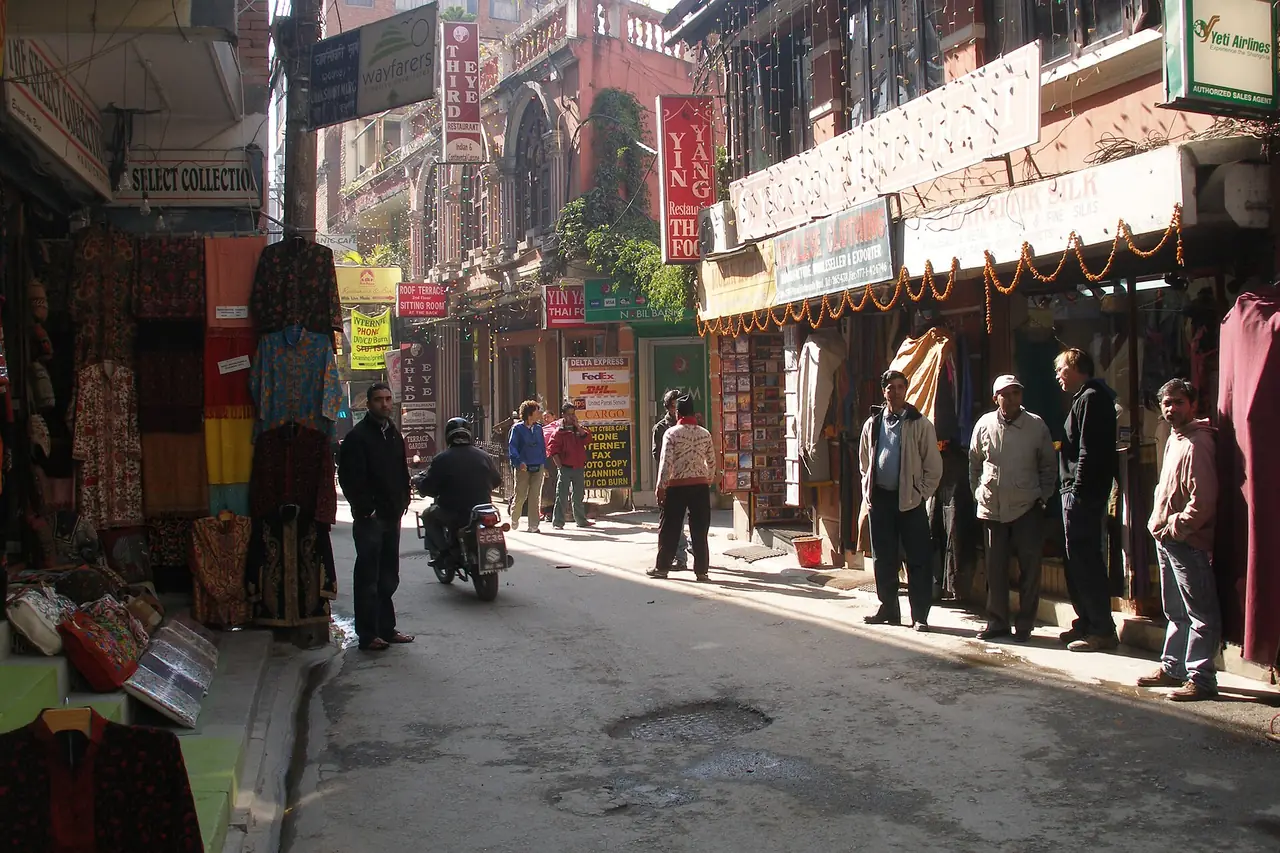
- Thamel is the tourist hub, with guesthouses, restaurants, trekking-gear shops and travel agents. Its narrow lanes are busy with motorbikes and cars, and it is the centre of the city's nightlife.
- If someone on the street leads you to a hotel, Wikivoyage says they will usually be paid a commission by it.
- Patan, about 4 km south across the Bagmati River, offers more space and less chaos; its Jhamsikhel area, nicknamed Jhamel, is a calmer café quarter.
- Boudha is home to a Tibetan community with over 50 monasteries and its own guesthouses. Freak Street, by Durbar Square, was a 1960s hippie-trail hub; its guesthouses are simpler and often cost less than Thamel's.
- Bhaktapur's old town is quieter and nearer the airport, and Wikivoyage suggests it for a first night.
Sights in the city
- Kathmandu Durbar Square (Hanuman Dhoka) is the old royal palace square. Many buildings fell in the 2015 earthquake; Kasthamandap reopened in 2022 and the nine-storey palace in 2025, and some repairs may still be under way.
- The Kumari, a girl worshipped as a living goddess, lives in the Kumari Ghar on the square and appears only briefly at a window over the courtyard. Please stay quiet and keep cameras away; travel writers report that photographing her is forbidden.
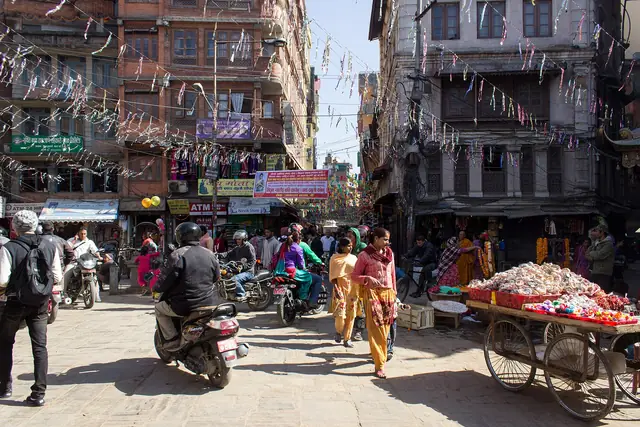
- Asan is an old bazaar where six streets meet, and the lanes around Indra Chowk are full of fabric shops and tailors.
- Swayambhunath, the Monkey Temple, crowns a hill west of the city; its monkeys may carry rabies, so please keep food out of sight. Boudhanath is one of the world's largest stupas.
- The Garden of Dreams, a restored 1920 garden at the entrance to Thamel, makes a green break from the streets.
Around the valley
- Bhaktapur, about 12 km east and 40–60 minutes by bus, is closed to cars in the old city, so it is lovely on foot. Wikivoyage says you can ask for your ticket to cover up to a week.
- Kirtipur, an old Newar hill town about 5 km south-west, is about 30 minutes by bus from Ratna Park and known for Newari food.
- Nagarkot, 32 km north-east at about 2,160 m, looks out to Langtang, Manaslu and, on clear days, Everest's tip. It is two hours away, so stay a night for sunset and sunrise; cloud can hide the view even in autumn.
- The Chandragiri cable car climbs from Thankot in about 10 minutes to views of the valley and the Himalaya. It reopened in November 2025 after its lower station was burnt in that September's protests.
A one- to three-day plan
- Day one: walk from Thamel past the Garden of Dreams, through Indra Chowk and Asan to Durbar Square, then Swayambhunath.
- Day two: Pashupatinath (open 4 am to 9 pm) and Boudhanath. The temple trust gives two times for the evening aarti, so please check on the day.
- Day three: Patan (about 90 minutes' walk from Thamel) or Bhaktapur with a Newari lunch, or Nagarkot overnight.
Newari food
- Samay baji is a festive platter: beaten rice with fried soybeans, bara, spiced buffalo meat, ginger, egg, potato and pickle, often with a little aila.
- Bara (wo) is a fried lentil cake, and in Bhaktapur it comes topped with an omelette. Chatamari, sometimes called Nepali pizza, is a rice-flour crepe topped with egg, mince or onion.
- Yomari is a steamed rice-flour dumpling filled with molasses and thickened milk, made for Yomari Punhi, the winter full moon at the end of the rice harvest.
- Kwati, a soup of nine sprouted beans, is eaten at the Janai Purnima full moon. Choila is buffalo meat grilled, cut small and marinated: smoky, spicy and tangy.
- Find a bhatti in Kirtipur, Patan, Bhaktapur or around Basantapur. Buffalo is the usual meat, so if you would like vegetarian dishes, please ask.
Street food
- Momo come steamed, fried, as kothey (steamed then pan-fried), as C-momo in chilli sauce, or as jhol momo in a spiced broth, a Kathmandu winter favourite.
- Laphing, cold mung-bean noodles in a garlic, Sichuan-pepper and chilli-oil sauce, is a Tibetan favourite around Boudha.
- Panipuri (crisp shells dipped in sour water) and chatpate (spiced puffed rice) are the city's most popular snacks; our food guide explains water safety.
- Sekuwa is meat grilled over charcoal, sel roti a ring-shaped rice bread, and chiya, milky spiced tea, is everywhere.
Beer and local drinks
- Everest and Gorkha are the best-known local beers, and the Nepali craft range Barahsinghe had six beers by 2023.
- Newars make aila, a distilled spirit served with samay baji, and thwon, a rice beer.
- Wikivoyage advises against home-made chhyang, raksi and tongba, which may contain methanol. For the drinking age and drink safety, please see our food guide.
Getting around and being a good guest
- Walking suits the old city. For taxis, Wikivoyage's undated figures are around NPR 500 from Thamel to Patan (its Patan page says 200–350) and 1,000–1,500 to Bhaktapur; our getting-around guide covers ride apps.
- Pickpockets work crowded places, and Wikivoyage warns that strangers offering to take you to dance bars can lead to tourists being ripped off.
- Take off your shoes before temple buildings, walk clockwise around stupas, and please don't climb on statues or point your feet at shrines.
- Leather and photography aren't allowed inside Pashupatinath's main temple, and cremations are a family's private grief, so please put the camera away near a pyre.
Photos

Sources
- Wikivoyage — Kathmandu
- Wikivoyage — Patan
- Wikivoyage — Bhaktapur
- Wikivoyage — Kirtipur
- Wikivoyage — Nagarkot
- Wikivoyage — Nepal (drink, respect)
- Nepal Tourism Board — Kathmandu Valley
- Nepal Tourism Board — Pashupatinath
- Pashupati Area Development Trust
- Wikipedia — Thamel
- Wikipedia — Freak Street
- Wikipedia — Garden of Dreams
- Wikipedia — Swayambhunath
- Wikipedia — Boudhanath
- Wikipedia — Asan, Kathmandu
- Wikipedia — Kumari (goddess)
- Gulf News — On a heritage high (Kumari Ghar visit, 2 March 2007)
- The Himalayan Times — Kashthamandap temple inaugurated (5 April 2022)
- Onlinekhabar — Historic nine-storey palace in Basantapur reopens to the public (21 May 2025)
- The Rising Nepal — Hanumandhoka reconstruction progress (24 January 2023)
- The Himalayan Times — Hanumandhoka Durbar Square revenue and fees (5 September 2025)
- Wikipedia — Chandragiri Cable Car
- Ekantipur — Chandragiri Cable Car and Resort reopen after 60 days (8 November 2025)
- Nepali Times — Chandragiri by cable car (21 October 2016)
- Wikipedia — Newa cuisine
- Wikipedia — Samay baji
- Wikipedia — Chatamari
- Wikipedia — Yomari
- The Kathmandu Post — Janai Purnima festival being observed today (22 August 2021)
- Onlinekhabar — The best street food in Kathmandu (26 March 2023)
- Wikipedia — Momo (food)
- Wikipedia — Jhol momo
- Wikipedia — Beer in Nepal
- The Himalayan Times — Yak Brewing launches Barahsinghe Belgian-style witbier (20 October 2023)
Fees and rules checked on 2026-11-02.
Getting to Nepal · Arriving at Kathmandu airport · Nepali words to know before you land · What's normal in Nepal, and might surprise you · Phones, SIM cards and internet in Nepal · Getting around Nepal · Money in Nepal · Staying safe in Nepal · What to pack for Nepal · Food and drink in Nepal · Kathmandu after dark: where to hang out, eat, drink and dance · Paragliding in Nepal: Sarangkot, other sites and how to fly safely · Bungee jumping in Nepal · Rafting and kayaking in Nepal · More adventure in Nepal: zipline, canyoning, mountain biking, climbing and more · Visiting Nepal's sacred sites: a pilgrim's guide
Start here · Trekking · Sightseeing · Adventure · Pilgrimage
General guidance from the sources listed, not a guarantee. Rules, fees and trail conditions change; confirm with the official source or a registered trekking agency before you go.