Kathmandu after dark: where to hang out, eat, drink and dance
Kathmandu's evenings range from candle-lit temple squares and quiet rooftop teas to live bands and late dance floors in Thamel. Here is where people go, what the rules are, and how to get home safely.
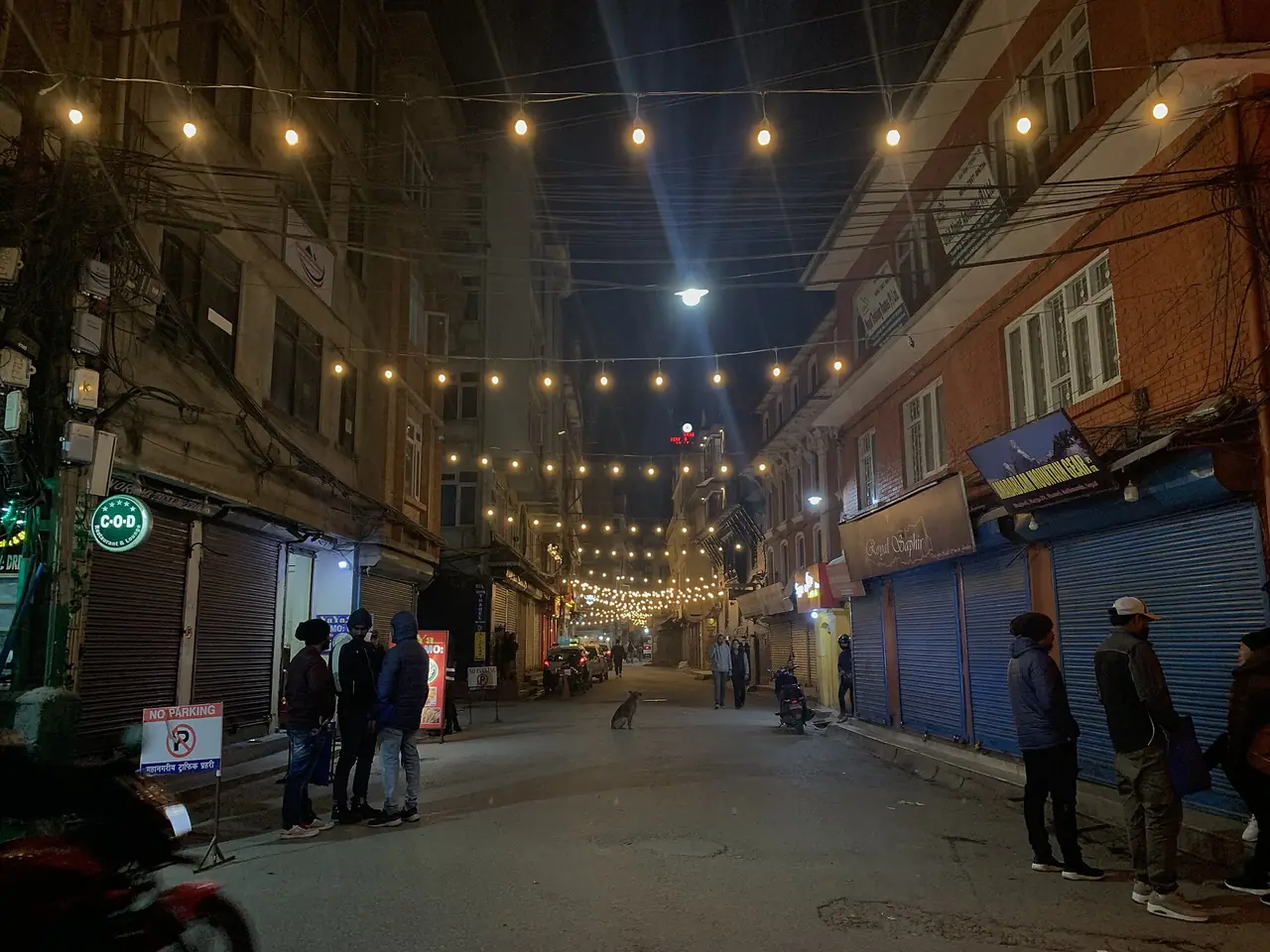

Current notice: Thamel and Durbar Marg have been allowed to open round the clock since 13 April 2024, with conditions (soundproofing after 10 pm, no under-18s, extra rules for venues open to 4 am). Noise complaints were reported in September 2024, and police arrested 13 people for harassing and robbing tourists in Thamel in November 2025 and three dance-bar staff for overcharging foreign tourists in July 2026. Tihar, the festival of lights, falls on 7–11 November 2026, with Laxmi Puja on Sunday 8 November.
The essentials
- Thamel is the centre of the city's nightlife; since 13 April 2024 it and Durbar Marg may stay open round the clock, but noisy venues without soundproofing must close at 10 pm.
- Bars, pubs, clubs and discos must not let in anyone under 18.
- Menu prices should already include VAT, and the Supreme Court banned service charges in 2023; tipping is voluntary.
- Please politely decline anyone in the street offering to take you to a dance bar; overcharging tourists there has led to arrests as recently as July 2026.
- Home-made spirits can contain methanol, which you cannot taste or smell; stick to sealed bottles.
- Tourist Police: dial 1144 (toll-free), available round the clock in the Kathmandu Valley. Police: 100.
Where people go, by area and mood
- Thamel, about 1.4 km north of Kathmandu Durbar Square, is widely seen as the centre of Kathmandu's nightlife: pubs, clubs, live music, rooftop restaurants and cafés serving Nepali and continental food, all packed into narrow lanes.
- Durbar Marg, the wide avenue by the old royal palace, shares Thamel's round-the-clock permission and has bars and restaurants of its own.
- Jhamsikhel, nicknamed Jhamel, in Patan was once a quiet residential area; it now has many restaurants, cafés, bars and even a few nightclubs, and is known for brunch and drinks.
- Nearby Pulchowk has cafés with outdoor seating, and Wikivoyage notes bars with good music in Jhamsikhel and Jawalakhel.
- Boudha is the place for a quiet evening: cafés with rooftop seats look over the stupa, which glows under warm floodlights at night. Wikivoyage says most shops and restaurants there close by 8 pm, so plan dinner early.
- Patan and Bhaktapur's Durbar Squares and Basantapur (Kathmandu Durbar Square) are lovely at dusk for a slow walk and a cup of tea, but they are old towns that go to bed early rather than nightlife areas.
Eating out in the evening
- For Newari food, the valley's own cuisine, try bara (lentil patties), choila (spiced grilled meat), chatamari, yomari and samay baji, a set of beaten rice, buffalo meat, lentils and pickles. Look around Patan's Mangal Bazaar, Kirtipur and Bhaktapur, where you can finish with juju dhau, the 'king of yoghurts'.
- Small Newari eateries often close early: Wikivoyage lists one in Patan open until 8.30 pm, so go for an early dinner if Newari food is your aim.
- Sekuwa is meat (buffalo, pork, chicken or mutton) marinated in spices and grilled, ideally over wood or charcoal, and eaten with beaten rice and pickle. Onlinekhabar names Chabahil, Sinamangal, Dillibazar, Kapan and Pyaphal near Basantapur among the areas known for it.
- Momo, steamed dumplings, are everywhere; Wikivoyage gives about Rs150–250 a dozen depending on the area and filling.
- In Boudha the food leans Tibetan and Nepali, with momo and thukpa (noodle soup) common, and vegetarian and vegan dishes are easy to find there.
- On the bill: the Supreme Court ruled in January 2023 that service charges are illegal, and an earlier court ruling says you should not pay more than the menu price, so VAT should already be included. Wikivoyage still reports tourist restaurants adding 10% service charge and 13% VAT, so please check the menu's small print before you order; tipping is voluntary.
Bars, live music and dancing
- Since 13 April 2024 the government has allowed Thamel (except the Bhagawanbahal area) and Durbar Marg to operate round the clock. Clubs, dance venues, folk-song venues and discos are included, and the District Administration Office in Kathmandu is in charge of security.
- The conditions matter to you as a guest: venues open after 10 pm must be soundproofed, those open until 4 am must arrange transport home for drunk customers, and anyone under 18 must be kept out of bars, pubs, clubs and discos.
- In practice many places still close much earlier. Kathmandu Post reported that venues without proper soundproofing must close at 10 pm, and Kantipur reported noise complaints from tourists and residents in September 2024, so please keep your voice down in the lanes late at night.
- Dohori is Nepal's improvised, back-and-forth folk duet. In the city, restaurants advertising a 'dohori sanjh' (dohori evening) stage these songs while guests eat, drink and sometimes dance; Himal Southasian notes the audience is mostly men.
- Local beers include Gorkha and Everest, and Wikivoyage says local beers tend to be more reliable than imports. Raksi is a clear home-distilled spirit of around 45% alcohol, and jaand or chhyang is a cloudy rice beer, often diluted with water, so ask whether the water was treated.
- Nepal's tobacco law of 2011 bans smoking in public places, and Kathmandu Metropolitan City reintroduced its ban in 2022, with fines of Rs100 to Rs100,000 under the Act. Enforcement varies, but please step outside and away from crowds to smoke.
Touts and dance bars
- Wikivoyage advises against following people in the street who offer to take you to a dance bar, because several tourists have been ripped off inside.
- In July 2026 police in Kathmandu arrested three people, including dance-bar staff, for overcharging and threatening foreign tourists at dance bars, clubs and restaurants.
- In November 2025 police arrested 13 people accused of harassing and robbing domestic and foreign tourists in Thamel.
- The simplest guard is to choose where you go yourself, check prices before ordering and pay as you go, and walk away politely if anyone pushes.
Staying safe and getting home
- Please never leave your drink unattended or accept one from a stranger; the UK government gives this advice for Nepal.
- Methanol can turn up in home-made or illicit spirits; you cannot taste or smell it, and even a little can be fatal. Kathmandu Post reported six deaths from toxic local liquor in Dhanusha in 2018, so please choose sealed, branded bottles and get medical help fast if anyone feels very unwell after drinking.
- Pickpockets and bag-snatchers work in crowded places such as Thamel, and assaults and robberies are more likely in poorly lit areas at night. Carry little cash, keep valuables in your hotel safe and walk with others.
- Women have been sexually assaulted in tourist areas such as Thamel and Sanepa, the UK government warns, so please take extra care when alone after dark and use a ride app or a taxi your hotel calls.
- Wikivoyage says taxi fares are higher after dark, meters are rarely used so agree the fare first, and after 10 pm taxis are hard to find away from central tourist areas and big hotels. It gives about Rs500 from Thamel to Patan; in Boudha, taxis wait on the main road until about 9 pm.
- Ride apps help: inDrive accepts international phone numbers (check the pickup pin, which is sometimes off), while Pathao and Tootle need a Nepali number. Tourist Police are on 1144, toll-free and available round the clock in the Kathmandu Valley; general police are on 100.
Power, drugs and quiet hours
- The scheduled daily power cuts (load-shedding) of the past ended for homes in 2017 and for the whole country in May 2018. Supply can be less steady in the dry season, and many lanes are poorly lit, so a small torch is useful.
- Drug penalties are severe: the UK government says even a small amount of cannabis can bring more than five years in prison, and CBD products, including some vape refills, are illegal.
- Public displays of affection are seen as inappropriate by many Nepalis, so please keep it low-key in the street.
- Old towns such as Bhaktapur, Patan and Boudha fall quiet early, and families live above many Thamel lanes, so please keep noise down late at night.
Festivals that change the night
- Tihar, the five-day festival of lights, runs from 7 to 11 November 2026. On Laxmi Puja (Sunday 8 November 2026; Friday 29 October 2027) homes are lit with candles and lamps to welcome the goddess of wealth, so an evening walk is a lovely way to see it.
- Holi, called Phagu Purnima in the hills, falls on the full moon of Phalgun, usually in March. In 2026 Kathmandu celebrated it on 2 March, and locals and tourists from many countries joined in at Basantapur.
- On Holi, expect coloured powder and water; wear old clothes, protect your phone and eyes, and remember that not everyone wants to be coloured.
Sources
- Kathmandu Post — Thamel now open 24/7 (13 April 2024)
- The Himalayan Times — Thamel to remain operational 24 hours from April 13 onward (11 April 2024)
- Republica — Govt enforces new guidelines for 24-hour operation of businesses in Thamel and Durbar Marg areas (April 2024)
- Onlinekhabar — No time limit on nightlife business operation in Nepal from now onwards (10 March 2022)
- Kantipur (English) — Thamel's night business suffering due to lack of code of conduct (3 September 2024)
- Kantipur (English) — 13 people arrested for harassing tourists in Thamel (26 November 2025)
- Ratopati — Three arrested in Kathmandu for overcharging tourists and assaulting police (30 July 2026)
- Kathmandu Post — No more service charge anywhere, top court says (27 January 2023)
- Kathmandu Post — KMC reintroduces ban on smoking in public places (16 September 2022)
- Kathmandu Post — Toxic liquor kills six people in Dhanusha (29 June 2018)
- Kathmandu Post — Entire country is now free of load-shedding (14 May 2018)
- Ministry of Culture, Tourism and Civil Aviation — Tourist Police
- UK FCDO — Nepal travel advice: safety and security
- Wikivoyage — Kathmandu
- Wikivoyage — Patan
- Wikivoyage — Bhaktapur
- Wikivoyage — Kirtipur
- Wikivoyage — Boudhanath
- Wikivoyage — Nepal
- Wikipedia — Thamel
- Wikipedia — Holi
- Onlinekhabar — Sekuwa places in Kathmandu (13 September 2021)
- Nepal Traveller — Jhamsikhel: then and now (15 September 2022)
- Himal Southasian — Jugalbandi: between town and country (25 January 2011)
- OUPblog — Festival dohori in the Kathmandu Valley (14 November 2017)
- Office Holidays — Laxmi Puja in Nepal (2026, 2027)
- Setopati — Holi celebrated in Basantapur (2 March 2026)
Fees and rules checked on 2026-11-02.
Getting to Nepal · Arriving at Kathmandu airport · Nepali words to know before you land · What's normal in Nepal, and might surprise you · Phones, SIM cards and internet in Nepal · Getting around Nepal · Money in Nepal · Staying safe in Nepal · What to pack for Nepal · Food and drink in Nepal · Kathmandu: where to stay, what to see and what to eat · Paragliding in Nepal: Sarangkot, other sites and how to fly safely · Bungee jumping in Nepal · Rafting and kayaking in Nepal · More adventure in Nepal: zipline, canyoning, mountain biking, climbing and more · Visiting Nepal's sacred sites: a pilgrim's guide
Start here · Trekking · Sightseeing · Adventure · Pilgrimage
General guidance from the sources listed, not a guarantee. Rules, fees and trail conditions change; confirm with the official source or a registered trekking agency before you go.