Rafting and kayaking in Nepal
Nepal's rivers run straight down from the Himalaya, so you can choose anything from a gentle half-day float to a ten-day expedition through wild gorges. Here is each river in turn, when to go, what it costs, the rules, and how to pick a crew who will bring you home safely.
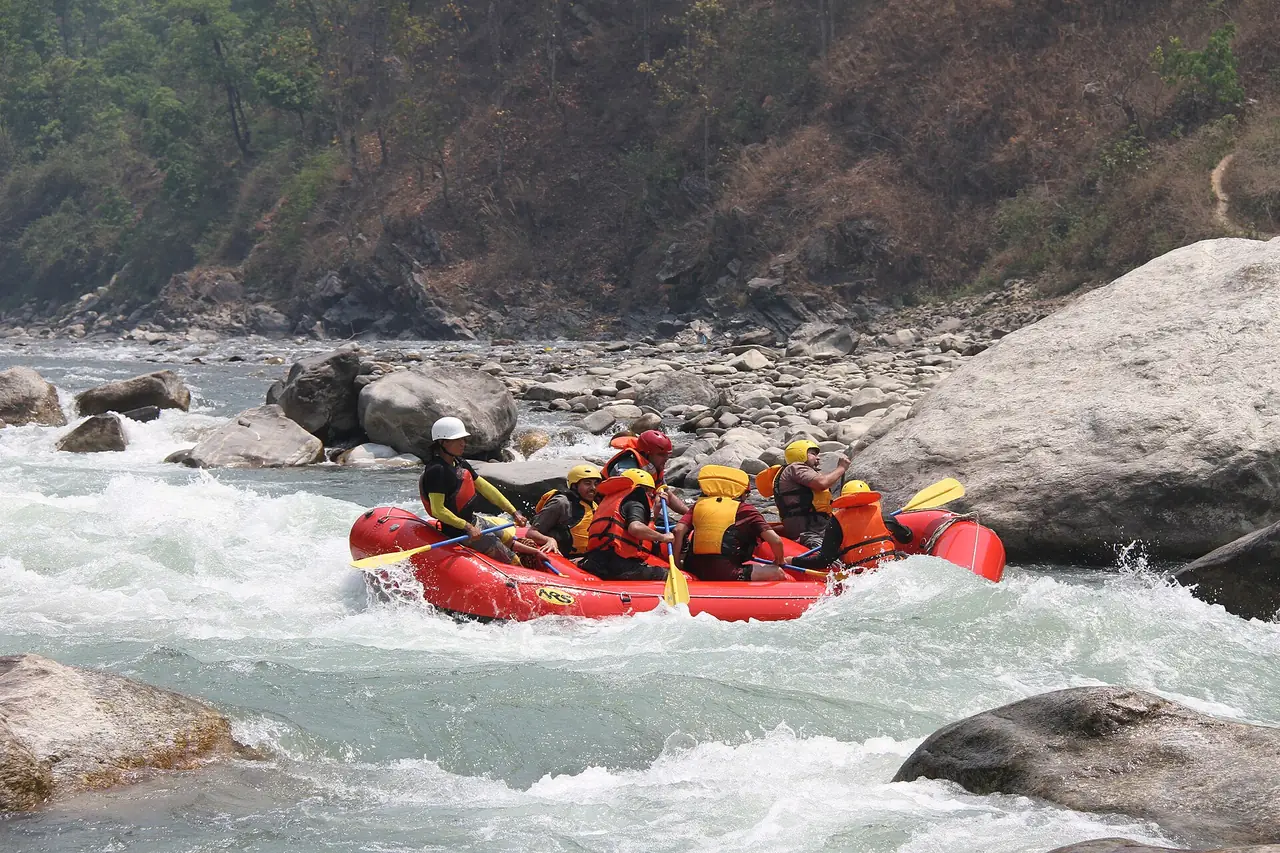

Current notice: After the 26 August 2026 flood, an operator update dated 2 November 2026 says NARA has declared the Trishuli open again and some companies are running trips. That same company is keeping its own Trishuli trips suspended, because the flood changed channels and left hidden debris. Its Seti and Kali Gandaki trips near Pokhara have reopened. Ask any company how it has scouted the river this season.
The essentials
- Rafting happens in two seasons: autumn (about mid-September to November) and spring (March to May). In the monsoon the rivers carry ten times more water and are for experts only.
- First-timers usually start on the Trishuli (between Kathmandu and Pokhara), the Seti near Pokhara or the Upper Sun Koshi. The Bhote Koshi, Marsyangdi and Upper Kali Gandaki are for fit, confident swimmers.
- Nepal's Rafting Rules (2006) say you must raft with a licensed company, guided by licensed river guides, wearing a life jacket and helmet.
- Rough Guides gives about US$25–80 a day, depending on the river, group size and comfort.
- Make sure your travel insurance names whitewater rafting and covers helicopter rescue.
- The flood of 26 August 2026 changed the Trishuli. Ask the company how they have checked the river before you book.
Short trips from Kathmandu
- Trishuli (grade 3+ in Rough Guides; some operators say II–III+): this is Nepal's most-rafted river, and Rough Guides says roughly half of all trips run here. Trips last 1–4 days. The liveliest stretch runs from Charaudi to Kuringhat, above Mugling, and the main Kathmandu–Pokhara road follows the river. One operator puts the Benighat put-in about 75 km, or about 3 hours, from Kathmandu.
- The Trishuli suits first-timers, families and anyone short of time or money. Magical Nepal says most operators accept children from about 8 on the Trishuli and Seti. Expect other groups in October and November, because the river sits right beside the highway.
- Heading to Chitwan? Many people raft the Trishuli for a day or two on the way, then continue by road. Rough Guides says you may not raft all the way into Chitwan National Park, so the last part, from Narayanghat, is by vehicle.
- Bhote Koshi (grade 4+ in Rough Guides; Wikipedia gives IV–V at high flow and III at low): with a drop of about 15 m per kilometre, it is the steepest river rafted in Nepal. It runs beside the Araniko Highway towards the Tibetan border, about 3 hours from Kathmandu. Trips last one or two days and need fit rafters, empty back-up rafts and safety kayakers.
- Upper Sun Koshi, also called the Lower Bhote Koshi (grade 3): this is the gentler warm-up, 2–3 hours from Kathmandu, and a favourite for half-day trips and kayak schools. Below Sukute Beach the water goes flat. Kantipur (January 2026) puts the Sukute area about 70 km from Kathmandu, with more than ten riverside resorts that run rafting.
- Riverside resorts on the Bhote Koshi also run canyoning, bungee jumping and mountain biking (Rough Guides). The Himalayan Times (March 2025) counted more than nine canyoning spots in the Bhote Koshi valley, though only a few are commercial. Nepal has no nationally recognised canyoning guide licence, so ask which certificate the guide holds.
Short trips from Pokhara
- Upper Seti (grade 3+): this is a short burst of whitewater, about 90 minutes on the water, from just above Hyemja to the dam at Bajar. The put-in is about 30 minutes by road from Pokhara. Rough Guides says it runs at high water, from September to early November.
- Seti (grade 3−): this is a gentle 2–3 day float from Damauli towards Narayanghat, away from the road, with jungle banks and white-sand beaches for camping. The warm water makes it a favourite for birdwatchers, winter trips and kayak courses, and it is a good choice for families.
- Lower Kali Gandaki (grade 2): this is a quiet four-day float from Ramdi Ghat on the Siddhartha Highway, about 5 hours from Pokhara. Rough Guides says it is less busy than the Seti.
- Learning to kayak: Rough Guides says most kayak schools are in Pokhara. They teach a first half-day on Phewa Lake, then about four days on the Seti, and five-day courses started at around US$300 with gear, food and camping.
- Remember the Seti's 5 May 2012 flood, which killed 72 people. Rivers near Pokhara can rise suddenly after heavy rain upstream, even on a clear day in the city.
Multi-day classics
- Upper Kali Gandaki (grade 4−): this is a three-day trip from Pokhara through a deep, scenic valley, from near Baglung down to the dam at the Andi Khola confluence. Rough Guides says it is best at low to medium flows, from mid-October to mid-December and in March–April. It has had several accidents, so choose your operator carefully.
- Marsyangdi (grade 4+): this is continuous technical water, a non-stop slalom that needs a highly experienced crew. Trips start near Khudi or Bhulbule on the Annapurna Circuit, and November is the usual best month. A dam at Phaliya Sanghu, about 14 km south of Besisahar, splits the river into two sections.
- Sun Koshi (Rough Guides gives grade 4− in its table and 3–4 in the text; operators say III–IV+): this is a classic journey of 8–10 days, about 270 km from Dolalghat, about 3 hours east of Kathmandu, to Chatara in the eastern Terai. It starts gently, so Rough Guides calls it a good first big trip. It is best from mid-September to late October and in May to early June.
- Because a 'three-day' trip includes the drives, Rough Guides warns that the main day may have only about four hours of rafting. Ask how many hours you will actually spend on the water.
- Dams are changing the rivers. Onlinekhabar (February 2023) reported that the 45 MW Upper Bhotekoshi plant has run since 2001, with the 102 MW Middle Bhotekoshi nearly finished. Guides say dry-season rapids have become rare, and NARA has asked for the Bhote Koshi to be kept as a 'heritage river' for rafting. Rough Guides also notes dams ending runs on the Kali Gandaki and splitting the Marsyangdi.
Remote expedition rivers
- Karnali (grade 4): this is Nepal's longest and biggest river, in the far west. Trips last about 10 days, with 8 on the water, and the biggest rapids come in the first three days. You reach it by a long bus ride or a flight to Nepalgunj, then rough roads to Sauli or Dungeshwar. The river ends near Bardia National Park, where you may see wildlife from the raft, and Rough Guides likes March–April best.
- Bheri (grade 3+): this is a shorter, easier cousin of the Karnali, with 6–8 days on the water and lovely scenery. It is about 15 hours by bus from Kathmandu via Nepalgunj, and Rough Guides says few companies run it.
- Tamur (grade 4): in the far east, this is six days of whitewater from Dobhan, usually after a walk in over a high ridge (several days, or less if you fly). Rough Guides says it is best from late October to late November, at medium flows.
- Arun: operators run trips of about 5–6 days from Tumlingtar towards Chatara, but they give grades from III–IV to V. Ask exactly which section you will raft and what grade it is.
- Upper (Humla) Karnali: Rough Guides grades it 5 and says it is only for expert kayakers. On any remote river a rescue can take hours or days, so a guide's training and the team's first-aid kit matter even more.
Seasons and water levels
- In the monsoon (roughly June or July to mid-September) the rivers carry ten or more times the water of February–March (Rough Guides). Wikipedia says rafting is dangerous then and is not normally run, and the UK government warns that monsoon travel can be hazardous because of floods and landslides.
- Late September to early October brings high water left over from the monsoon. Waves are bigger and swims are longer, and Rough Guides notes that trips go faster at high water. Mid-October to November is the peak season, with fun but manageable rapids and clear mountain views.
- December to February is calmer, but the water is very cold, and many companies stop running trips. On the snow-fed Bhote Koshi, choose a company that lends wetsuits and paddle jackets in winter.
- From March to May the snowmelt and pre-monsoon storms slowly raise the rivers again. The weather is warm and the birdwatching is good, though Wikipedia notes that smaller rivers can run quite low in spring.
- Each river has its own best months, as listed above, so let your travel dates help you choose the river rather than the other way round.
Prices and booking
- Rough Guides gives US$25–80 a day. It says comfortable trips on the Trishuli and Kali Gandaki cost about US$30–40 a day with private transport and meals, and budget trips about US$25 by local bus. Remote rivers cost an extra US$10–20 a day. These guidebook figures may be several years old.
- One operator's listing seen in November 2026 gave a one-day Trishuli trip at NPR 3,500 for foreigners (US$25 as an offer), including the safety kayak, helmet and life jacket. A 2026 operator guide gives US$45–75 for a Trishuli day and US$70–100 for a lower Bhote Koshi day.
- For longer trips, the same 2026 operator guide lists about US$450–700 for the Sun Koshi and US$650–900 for the Karnali, with flights extra. These are advertised prices, not official rates.
- Rough Guides says agents in Thamel and Lakeside often add their own commission, so booking with the rafting company itself is usually clearer. Popular high-season trips can fill months ahead.
- Several 2026 guides say no government rafting permit is needed now. Wikipedia says the old per-river permit was dropped in 1999. If a 'permit fee' appears on your bill, politely ask what it is for.
Rules and licences
- The Rafting Rules, 2063 (2006), made under the Tourism Act, say that only licensed companies may run rafting trips and that tourists must raft only with a licensed company. Foreigners may raft only on rivers opened for rafting.
- Each company must own at least two rafts and must give every rafter a life jacket and a helmet. It must record your name and address before the trip and carry out search and rescue after an accident.
- River guides need a government river-guide licence, which requires training from a recognised institution. The rules also require guides to rescue rafters in an emergency, and they forbid guides from lending their licence to anyone else.
- The Nepal Association of Rafting Agencies (NARA), registered on 26 December 1989, represents the rafting and kayaking companies. Rough Guides advises using only NARA members, because NARA sets safety standards, insists on licensed guides and handles complaints.
- Rules on paper are not always followed on the river. Republica reported (23 May; the page shows no year) that the Valley Tourism Office found unlicensed guides rafting on the Bhote Koshi, and NARA warned its members not to use them.
- The 2006 rules do not mention safety kayakers. Rough Guides says you should insist on them on high water or anything above grade 2, together with self-bailing rafts.
Accidents and floods: what went wrong
- On 14 December 2017 a 24-year-old French man died on the Karnali in Kalikot when his raft capsized. He and two friends were four days into a trip from Mugu (Kathmandu Post).
- In mid-November 2018 an Australian died on the Karnali at Triveni, Kalikot, after a capsize (SBS, 16 November 2018). SBS later reported a 31-year-old Tasmanian kayaker, Adrian Kiernan, died on the Karnali that month. On 29 November 2018, Cassandra Emary, 23, died after a kayaking accident on the Seti near Pokhara. These very remote rivers leave little room for error.
- On 26 October 2015 a raft with 13 people aboard hit a tree on the Karnali bank in Bardiya while going fast, and it overturned. One person died and two went missing (Himalayan Times). This is why guides keep clear of trees and branches in the current.
- Floods are the bigger danger. On 2 August 2014 the Jure landslide blocked the Sun Koshi, killing 156 people and creating a lake that took 45 days to drain. On 8 July 2025 a flash flood from Tibet down the Rasuwa Bhotekoshi (the top of the Trishuli) killed at least nine people.
- On 26 August 2026 a huge ice-and-rock avalanche from Langtang Lirung became a debris flow down the Trishuli. Wikipedia, citing official figures, gives at least 1,455 dead and 5,285 missing by 5 October, many of them hydropower workers and foreign visitors. Rough Guides' advice stands: if you hear a strange roar from upstream, get to high ground at once.
Choosing an operator and insurance
- Ask to see the company's tourism licence and NARA membership, and ask to meet your guide before you pay. Check that the guide holds a river-guide licence and first-aid training, has run that exact section before and speaks enough English to give clear commands.
- Look at the gear. Life jackets should be in good condition and fit snugly, and helmets should be proper whitewater helmets. You want a full first-aid kit, throw bags, rafts in good repair and at least two boats on the trip. On grade 3+ water, and on any river at high water, there should be safety kayakers and self-bailing rafts.
- A good company gives a proper safety briefing before you get in. It covers how to sit and paddle, the guide's commands, how to swim a rapid feet first, and how to be pulled back into the raft. If nobody explains what to do if you fall in, that tells you something.
- Rough Guides notes that a full raft takes up to seven paying passengers. It is worth asking who else is on your trip, and whether they are at the same level as you.
- Many policies exclude 'whitewater' or grade 4–5 rafting, so check that yours names it and covers helicopter rescue. Rough Guides says helicopters need cash up front or a payment guarantee from your insurer, so leave a copy of your policy with the company, with the emergency number marked. The UK government also stresses helicopter cover.
What to bring, staying well, and river manners
- Bring swimwear, quick-dry clothes (not cotton), shoes or sandals with a heel strap, sunglasses on a strap, a sun hat, strong sun cream, a towel and a full change of clothes for the drive back. On overnight trips, also bring a head torch and a sleeping bag, which you can hire in Kathmandu or Pokhara.
- The sun reflects off the water, so cover up and reapply sun cream. Snow-fed rivers are cold even on a hot day, so bring thermal layers in spring and late autumn. Better companies lend wetsuits and paddle jackets, and a chilled, tired rafter makes mistakes.
- Leeches are a problem mainly in the monsoon (about June to early September) in low, forested places, so they are rarely an issue in the rafting seasons. If one bites on a riverside walk, Nepal Traveller suggests sprinkling salt on it so it drops off.
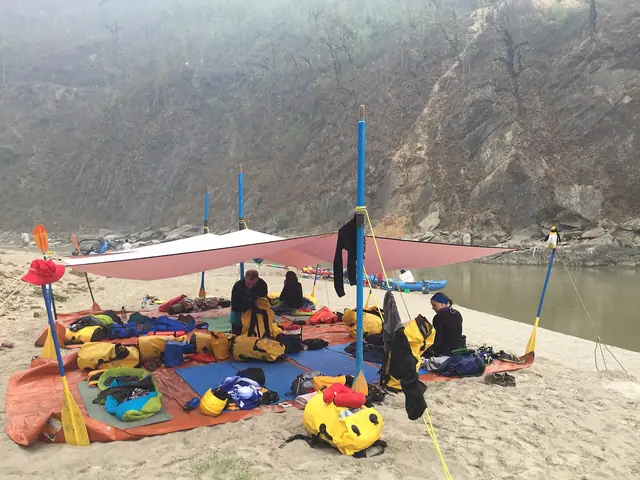
- Camp like a good guest. The Rafting Rules require companies to sort rubbish into burnable and recyclable waste, and to burn or bury only the burnable kind well away from water, with a witness. Rough Guides asks rafters to follow trekking manners on firewood, toilets and litter.
- Rivers such as the Trishuli feed villages and drinking water downstream, and after the 2026 flood, communities along it are still grieving and rebuilding. Please be gentle with your camera and generous with your patience.
Photos


Sources
- Rough Guides — Rafting and kayaking in Nepal (guidebook chapter, undated online)
- Rough Guides — The Karnali (river table)
- Rough Guides — The Seti (river table)
- Rough Guides — The Central Hills (Bhote Koshi adventure resorts)
- Wikipedia — Rafting in Nepal
- Wikipedia — Trishuli River
- Wikipedia — Bhote Koshi
- Wikipedia — 2014 Sunkoshi blockage
- Wikipedia — 2026 Nepal floods
- Wikivoyage — Nepal
- Nepal Law Commission text via NepalArchives — Rafting Rules, 2063 (2006), amended 2065 (2008)
- Nepal Association of Rafting Agencies (NARA) — official site
- NARA — 24th Himalayan White Water Challenge and 50th International Rafting & Kayaking Festival (March 2026)
- Kantipur (English) — 3-day international rafting festival concludes in Trishuli (12 March 2026)
- Republica — Unlicensed river guides found operating rafting services (23 May; year not shown on page)
- Kantipur — Crowds rafting on the Bhotekoshi–Sunkoshi in winter (in Nepali, 25 January 2026)
- Kathmandu Post — Rafting activities back to normal in Bhotekoshi and Sunkoshi rivers (4 April 2023)
- Onlinekhabar — Hydropower projects and river ecology on the Bhotekoshi (6 February 2023)
- Kathmandu Post — Flood from Tibet leaves trail of destruction in Rasuwa (10 July 2025)
- Kathmandu Post — Bhotekoshi flood blocks Syabrubesi–Rasuwagadhi road again (30 July 2025)
- Kathmandu Post — Bhotekoshi swells ominously (19 September 2016)
- Kathmandu Post — French man dies in rafting accident (15 December 2017)
- SBS News — Australian dies in Nepal rafting accident (16 November 2018)
- SBS Nepali — Third Australian adventurer dies in Nepal within a month (4 December 2018)
- The Himalayan Times — 1 dead, 2 missing as raft overturns in Karnali (26 October 2015)
- The Himalayan Times — Canyoning: a hidden adventure gem awaits spotlight (4 March 2025)
- Nepal Traveller — Jalbire Canyon: Nepal's waterfall playground (23 April 2026)
- Nepal Traveller — Trekking during the monsoon season in Nepal: tips (29 April 2025)
- Operator river-conditions update (Paddle Nepal) — Upper Seti and family rafting reopen (2 November 2026)
- Operator guide (Magical Nepal) — Rafting in Nepal: rivers, costs, seasons and safety (2026)
- Operator listing (Excellent Trek) — One-day Trishuli rafting prices (seen November 2026)
- Spotlight Nepal — Cyclone Arnab to weaken after Saturday afternoon (30 October 2026)
- UK FCDO — Nepal travel advice: safety and security
Fees and rules checked on 2026-11-02.
Getting to Nepal · Arriving at Kathmandu airport · Nepali words to know before you land · What's normal in Nepal, and might surprise you · Phones, SIM cards and internet in Nepal · Getting around Nepal · Money in Nepal · Staying safe in Nepal · What to pack for Nepal · Food and drink in Nepal · Kathmandu: where to stay, what to see and what to eat · Kathmandu after dark: where to hang out, eat, drink and dance · Paragliding in Nepal: Sarangkot, other sites and how to fly safely · Bungee jumping in Nepal · More adventure in Nepal: zipline, canyoning, mountain biking, climbing and more · Visiting Nepal's sacred sites: a pilgrim's guide
Start here · Trekking · Sightseeing · Adventure · Pilgrimage
General guidance from the sources listed, not a guarantee. Rules, fees and trail conditions change; confirm with the official source or a registered trekking agency before you go.