Paragliding in Nepal: Sarangkot, other sites and how to fly safely
Floating over Phewa Lake with the Annapurnas in front of you is one of the loveliest things you can do in Nepal, and you need no experience: a tandem pilot does the flying. Here is how a flight works, what it costs, when to go, and how to choose a licensed, insured operator so you can relax and enjoy the view.
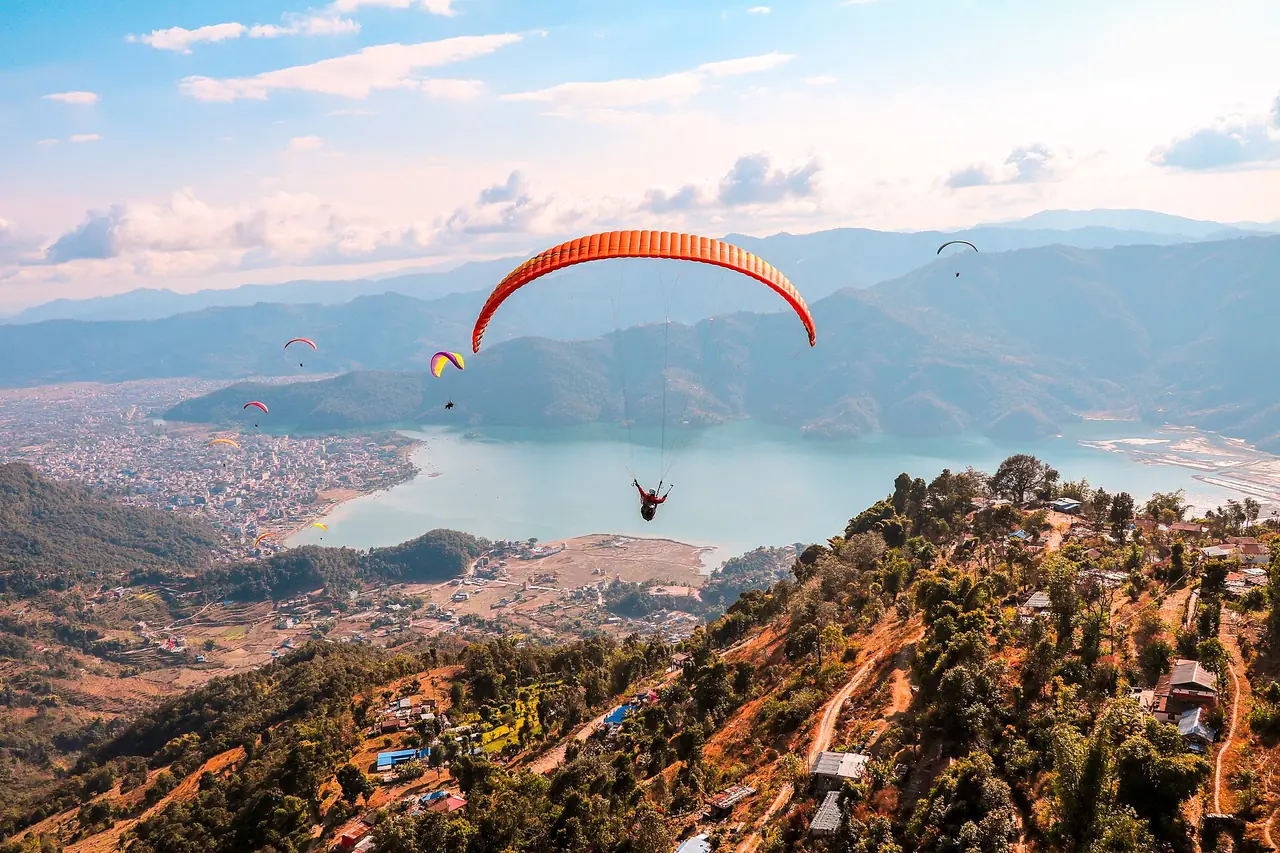

Current notice: Since 22 May 2025, paragliders in Pokhara may again take off from Sarangkot and Toripani and land by Phewa Lake, between 11 am and 4.30 pm, and since mid-July 2025 every glider a company flies must be registered with the Civil Aviation Authority of Nepal. Solo flying resumed in July 2025, and the Nepal Open championship returned in March 2026. Please check with your operator, as times and landing fields can change.
The essentials
- Most visitors fly tandem from Sarangkot (about 1,600 m) above Pokhara and land beside Phewa Lake; a standard flight lasts about 20–30 minutes.
- Operators list standard flights at about NPR 6,000–8,500 (2026 operator pages); longer cross-country flights cost more. Confirm what is included before you pay.
- Since 22 May 2025 the official flying window in Pokhara is 11 am to 4.30 pm, and flying is weather-dependent; the monsoon (roughly June–August) brings frequent cancellations.
- Every paraglider a company flies has had to be registered with the Civil Aviation Authority of Nepal (CAAN) since mid-July 2025; companies also need a tourism ministry permit.
- Many standard travel insurance policies do not cover paragliding. Check that yours covers tandem flights with a licensed operator, plus rescue and medical evacuation.
- In an emergency in Pokhara, dial 100 for police; the Armed Police Force keeps a rescue post on Phewa Lake.
What a tandem flight from Sarangkot is like
- Sarangkot is a hill of about 1,600 m just north of Phewa Lake, often called one of the best paragliding spots in the world (Wikipedia). You fly strapped into a harness in front of a qualified pilot, who steers and lands; you simply sit and enjoy it.
- Operators collect you from your hotel in Lakeside and drive you up by jeep or van; their pages give 20–40 minutes on a winding road. If you would rather walk, Wikipedia says the hike to Sarangkot from Miruwa on the Pokhara–Baglung road takes about 90 minutes, though you will still need to meet your company at the take-off.
- At the top the pilot gives a short briefing (the Kathmandu Post put it at about 15 minutes in 2019): usually how to run a few steps into the wind at take-off, how to sit back into the harness, and how to lift your legs for landing.
- Once airborne, pilots circle in rising warm air (thermals) to gain height; one operator says you can climb to 2,500–3,000 m on a good day, and that it can feel 8–12°C cooler than on the ground, so a warm layer is welcome.
- Flights land on fields at the western end of Phewa Lake. The landing returned to Khapaudi on the lake shore on 22 May 2025 after a spell at Pame (Rising Nepal); some 2026 operator pages still name Pame, so ask where you will land.
- Take-off can also be from Toripani, a little to the west. When Pokhara's new international airport opened on 1 January 2023, flying at Sarangkot and Toripani was stopped and moved about 5 km west to Mandredhunga (Himalayan Times), and pilots told Republica that March they were flying only about one day a week. From 22 May 2025 CAAN allowed take-offs from Sarangkot, Toripani and Bahakot again.
Flight options and typical prices
- A standard tandem flight lasts about 20–30 minutes. The Kathmandu Post (2019) found flights averaged 25–30 minutes, and two Pokhara operators listed 20–30 minutes at Rs 8,000 in March 2023.
- A cross-country (XC) flight stays up longer, usually 40–60 minutes, and travels further from the take-off. In 2023 the Kathmandu Post listed Rs 11,000–16,000; 2026 operator pages list NPR 9,000–13,000.
- For standard flights, 2026 operator pages list about NPR 6,000–8,500 and say the same rate applies to Nepali and foreign visitors. Wikivoyage gives US$120 (undated), and booking websites often charge more than operators in Lakeside.
- Acrobatic flights, with spirals and wingovers, are offered by some pilots; one operator says the price is on request and the flights suit people who already feel at ease in the air.
- Operator pages say a standard price usually includes Lakeside hotel pick-up and drop-off, the pilot, helmet and harness, basic flight insurance and taxes. Photos and video from a camera on the pilot's hand are sometimes included and sometimes about NPR 1,000 extra, so please ask before you book.
- Pilots' tips and pick-ups from outside Lakeside are usually not included. It is fair to ask for the full price in writing, in rupees, before you pay.
When to fly: seasons, weather and time of day
- The Kathmandu Post (2023) says Nepali companies fly all year except in the monsoon. Operators name late September to May as the main season, with October to December for the clearest views, and say June to August brings cloud, unpredictable wind and frequent cancellations.
- Spring storms are a real hazard: the Rising Nepal noted in March 2026 that storms are common in Pokhara in March and April, which is why pilots get weather briefings and rescue boats wait on the lake.
- Operators say mornings are calmer and that thermals grow stronger towards midday, giving longer but bumpier flights. Since 22 May 2025, though, the officially permitted window in Pokhara is 11 am to 4.30 pm (up from 11 am to 3 pm), so early-morning slots may not be possible; ask your operator what times it can actually fly.
- Pokhara's weather can change quickly. The Kathmandu Post reported in 2019 that there was no weather tower at the site, just a windsock, so pilots rely on their training to read the clouds and wind.
- If your company cancels or delays because of wind or cloud, it is doing the right thing. Please don't push a pilot to fly; it helps to keep a spare morning or day in your Pokhara plans.
- Flying can also stop for reasons other than weather: CAAN grounded all paragliding for a week in October 2022 after a fatal accident, and suspended flights over Pokhara in mid-December 2023 during a dispute over fees and the turn system (Onlinekhabar).
Can I fly? Weight, age, health and what to wear
- Weight limits vary by company. One operator gives about 25–90 kg; another says most accept 15–100 kg but some stop at 90–95 kg. Be honest about your weight, because the glider and harness are rated for a total load.
- Children can often fly with a parent's or guardian's consent. Operators give a minimum age of about 5, with some setting 10–12, and say there is no fixed upper age for people in reasonable health.
- If you have heart, back, neck or joint problems, are pregnant, or have had recent surgery, please check with your doctor and tell the company before you book: take-off needs a few running steps and landing can be a bump.
- Some people feel queasy when the glider banks or turns tightly. An operator suggests a light breakfast rather than a big meal; it helps to tell your pilot you would like a gentle flight, and to say at once if you feel unwell.
- Wear closed shoes with grip (not sandals), long trousers and a windproof jacket, plus sunglasses and sun cream. Leave loose scarves and hats behind, and keep phones on a strap or in a zipped pocket so nothing falls.
How paragliding is regulated in Nepal
- Companies need an operating permit from the Ministry of Culture, Tourism and Civil Aviation and a Recreational Aviation Operation Certificate from CAAN (Onlinekhabar, June 2025). Flying is only allowed in zones CAAN has approved.
- From fiscal year 2082/83 (mid-July 2025), every solo and tandem paraglider a company owns must be registered with CAAN. Companies had a three-month window; unregistered gliders are illegal and owners face legal action.
- The Nepal Airsports Association (NAA) manages day-to-day flying in Pokhara, including turns and flight slots. The Rising Nepal counted 53 companies, 416 registered pilots and 265 active pilots there in March 2026, and the Nepali Times reported in July 2025 that CAAN was preparing to order the companies to merge into ten; we have not found a report that this has happened.
- After a fatal accident in October 2022, CAAN set five conditions for flying: approved areas only, pilots certified medically and psychologically fit, pilots in uniform, gliders inspected and certified airworthy by CAAN's inspectors, and advanced tandem and emergency rescue refresher training at least once a year.
- In 2019 the Kathmandu Post reported that a tandem pilot needs more than 1,000 hours of solo flying, health checks, first-aid training and an SIV (simulated in-flight incident) course; trainees fly solo for about 18 months before applying for a tandem permit.
- Operators told the Kathmandu Post (2019) that they insure passengers against accidents, injury and death. Cover amounts vary: one Kavre operator advertised Rs 3.7 million of accident cover in 2023 (Annapurna Express).
Accidents in Pokhara and what changed
- In February 2015 the Kathmandu Post reported 51 paragliding accidents in Kaski since 2008, with five deaths and one person missing; all those who had died were foreign solo pilots. Crowding of solo, tandem and trainee pilots in the same airspace was named as a major problem.
- In one week in March 2019, a Romanian solo pilot died after crash-landing in Phewa Lake and a Russian solo pilot died after hitting a hill, and two pilots were hurt elsewhere in Kaski. CAAN stopped solo flights, and the NAA moved solo pilots to a separate take-off at Mandre Danda and limited pilots to one shift a day (Kathmandu Post).
- On 19 March 2019 a tandem glider carrying a seven-year-old boy hit an electric wire while landing near Khapaudi, and both pilot and child were critically hurt (Himalayan Times). Wires and buildings near the landing area are one reason pilots need a clean approach and calm air.
- On 23 November 2020 a tandem glider fell near Camp Chowk, about 1.5 km short of the landing site; the pilot died and his passenger was badly hurt. The NAA's investigation found the pilot had let go of a brake line while reaching for a flower to give his passenger, sending the glider into a spin (Onlinekhabar, December 2020).
- On 16 October 2022 a 26-year-old pilot died in a cross-country race at the National Games when his glider collapsed minutes after take-off. CAAN grounded all paragliding nationwide; tandem flying resumed a week later under the five conditions above, but solo flying stayed banned until July 2025.
- On 11 June 2025 two tandem gliders came down in Phewa Lake while landing; the Armed Police Force team at the Phewa rescue tower brought all four people out safely (Rising Nepal, Republica). This is why rescue boats on the lake matter.
How to choose a licensed, insured operator
- Ask to see the company's tourism ministry permit and CAAN operating certificate, and whether its gliders are registered with CAAN under the 2025 rule. A properly run company will not mind being asked.
- Ask about your pilot: how long they have flown tandem, whether they hold a current tandem licence, and when they last did their yearly refresher training. Your pilot should be on duty in uniform, as CAAN requires.
- Ask what insurance covers you, for how much, and whether it includes hospital and evacuation costs. Get it in writing, and remember it may be far lower than what your own travel insurance would pay.
- Look at the kit before take-off: a helmet that fits and is fastened, a harness in good condition and lines without knots or fraying. The Kathmandu Post noted in 2019 that international practice is for pilots to carry a variometer, GPS and radio.
- Be wary of a price that is much lower than others or a seller who can't name the company that will fly you. Pokhara Metropolitan City barred ten companies from flying in March 2019 for not registering, so street sellers may not always be selling a legal flight.
- Listen for a proper briefing and a weather check. A good operator will delay or cancel when the wind is wrong.
Travel insurance that covers paragliding
- Paragliding is usually treated as an adventure or extreme sport, so many standard policies leave it out; you may need a higher level of cover or an adventure add-on, and you may have to declare it when you buy (Finder, July 2026).
- Cover often depends on you being a passenger on a tandem flight with a licensed commercial operator. Solo flying, competitions, paramotoring and hang-gliding are generally not covered.
- If you don't declare the activity or you break a policy condition, a claim can be refused, so please read the wording and, ideally, get the insurer's confirmation by email.
- The UK Foreign Office advises making sure your Nepal insurance includes rescue and helicopter costs. An evacuation from Pokhara to Kathmandu is expensive without it.
- Keep your policy number and the insurer's emergency phone line on your phone and on paper, and give a copy to someone you are travelling with.
Other places to fly in Nepal
- Bandipur (Tanahun): flights take off from Bandipur Bhanjyang (about 1,215 m) and land around 865 m (Republica). The Kathmandu Post (2023) listed flights of 15–30 minutes for Rs 7,000.
- Near Kathmandu: commercial flights from Chandragiri Hill (2,300 m) land at Chitlang (1,700 m) and began in October 2023; the Annapurna Express gave Rs 12,000 for foreign visitors including transport from Kathmandu. Flights from Jhyaure Deurali land at Patap in Shankharapur, about 25 km from the international airport; the Kathmandu Post (2023) gave US$100 for tourists.
- Also near Kathmandu: flights from Devisthan in Dhulikhel, Kavre, began in July 2023 at Rs 7,000 (Annapurna Express), and CAAN approved sites at Suryachaur Shivapuri in Nuwakot and Tistung in Makwanpur in January 2020 (Onlinekhabar). We could not find a reliable report of commercial flying from Nagarjun.
- Chitwan: commercial flights began on 14 April 2023 from Chaukidanda, landing on the bank of the Trishuli at Devghat, at Rs 8,000 (Onlinekhabar).
- Dharan, eastern Nepal: flights from the Bhedetar hills land near Dharan; the Kathmandu Post (2023) gave 30 minutes for Rs 7,000, with August to February as the best season. Kantipur reported in November 2025 that flights there are increasingly popular, especially with women.
- In November 2023 CAAN added zones at Manedanda (Ramechhap), Rapti (Dang), Chitlang (Makwanpur) and Andhikhola (Syangja). Smaller sites have fewer flights and less rescue cover than Pokhara, so the same questions about permits and insurance matter even more.
Ultralights, hang-gliding and paramotors
- Ultralight flights, in small light aircraft flown by a pilot with you on board, have run in Pokhara since 1996. Onlinekhabar (2017) described flights of about 15 to 90 minutes with views of the Himalayas and Pokhara's lakes, more personal than the big mountain flights from Kathmandu.
- In 2017 tickets cost Rs 7,500–33,500 depending on length. Kantipur reported in December 2025 that a flight which once cost about Rs 8,500 now costs Rs 17,500, and that both Nepali and foreign visitors are staying away because of the price.
- Ultralights have had fatal crashes over Pokhara (see the Pokhara page), so please ask the same questions as for paragliding: the operator's licence, the pilot's experience, what insurance covers you, and whether your own travel policy covers flying in a light aircraft.
- Republica has reported a hang-gliding test flight from Sarangkot by two visiting American pilots, organised with CAAN permission, but we have not found a regular commercial hang-gliding service in Nepal.
- We could not find a reliable source for regular paramotor joyrides in Nepal. Most travel insurers do not cover paramotoring or hang-gliding, so check carefully before trying either.
Photos


Sources
- The Rising Nepal — Paragliding landings return to Fewa Lake shore (23 May 2025)
- Nepal News — Pokhara paragliding: landing at Khapaudi and longer flying hours (22 May 2025)
- Kantipur (English) — Now again paragliding over Phewatal (22 May 2025)
- Himal Press — Khapaudi designated as landing site for paragliders in Pokhara (22 May 2025)
- Onlinekhabar — Unregistered paragliders to be declared illegal from next fiscal year (25 June 2025)
- Nepali Times — Merging paragliders (3 July 2025)
- Himal Press — Solo paragliding flight resumes in Pokhara (9 July 2025)
- Republica — Solo paragliding flights take off in Pokhara after nearly three years (July 2025)
- The Rising Nepal — Two paragliders crash in Pokhara (11 June 2025)
- Republica — APF rescues four paragliders after they crash into Phewa Lake in Pokhara (June 2025)
- The Rising Nepal — Pokhara set to host Nepal Open Paragliding Championship (19 March 2026)
- The Himalayan Times — Paragliding activities in Pokhara limited to Mandredhunga to avoid accidents (4 January 2023)
- Republica — Is paragliding dying a slow death in Pokhara? (March 2023)
- Onlinekhabar — Paragliding flights in Pokhara suspended (18 December 2023)
- Kathmandu Post — Tribhuvan Army Club player dies in paragliding accident during National Games (16 October 2022)
- Onlinekhabar — Nepal lifts paragliding ban (23 October 2022)
- Onlinekhabar — One killed, one injured in Pokhara paraglider accident (23 November 2020)
- Republica — Pilot killed, passenger injured in paragliding tragedy in Pokhara (November 2020)
- Onlinekhabar — Pokhara paraglider fall probe says pilot tried to pick flower for his client (13 December 2020)
- Kathmandu Post — Paragliding has taken off in Pokhara, but the risks are numerous (10 June 2019)
- Kathmandu Post — Civil Aviation Authority bans solo paragliding following third accident in a week (5 March 2019)
- Onlinekhabar — Pokhara paragliding: Russian national killed in second fatal accident of the week (5 March 2019)
- The Himalayan Times — Two persons including a minor injured in Pokhara paragliding accident (19 March 2019)
- The Himalayan Times — Pokhara metropolis imposes ban on 10 paragliding companies (19 March 2019)
- The Himalayan Times — Briton dies after falling off paraglider in Pokhara (23 January 2017)
- Kathmandu Post — Safety issues mar thriving paragliding biz (2 February 2015)
- Kathmandu Post — Taking to the skies (17 March 2023)
- The Annapurna Express — Paragliding starts in Chandragiri (26 October 2023)
- The Annapurna Express — Commercial paragliding begins in Kavre (16 July 2023)
- Onlinekhabar — Commercial paragliding flights start in Chitwan (14 April 2023)
- Republica — CAAN designates four new locations as paragliding zones in Nepal (13 November 2023)
- Onlinekhabar — Authority approves two new paragliding zones near Kathmandu (17 January 2020)
- Republica — Commercial paragliding in Bandipur soon (16 October, year not shown)
- Kantipur (English) — Women's craze for Sky Adventure Paragliding in Dharan (12 November 2025)
- Kantipur (English) — Ultralight flights in crisis due to high fees (20 December 2025)
- Onlinekhabar — Pokhara ultralight: aerial adventure in the Lake City (2 January 2017)
- Republica — Successful test flight shows hang-gliding potential in Pokhara (3 April, year not shown)
- Wikivoyage — Pokhara
- Wikipedia — Sarangkot
- Excellent Trek (operator) — Paragliding in Pokhara: price and booking (updated October 2026)
- Save Mountain Treks (operator) — Paragliding in Pokhara: complete guide for 2026 (8 May 2026)
- Finder — Travel insurance for paragliding and parasailing (updated 6 July 2026)
- UK FCDO — Nepal travel advice: safety and security
Fees and rules checked on 2026-11-02.
Getting to Nepal · Arriving at Kathmandu airport · Nepali words to know before you land · What's normal in Nepal, and might surprise you · Phones, SIM cards and internet in Nepal · Getting around Nepal · Money in Nepal · Staying safe in Nepal · What to pack for Nepal · Food and drink in Nepal · Kathmandu: where to stay, what to see and what to eat · Kathmandu after dark: where to hang out, eat, drink and dance · Bungee jumping in Nepal · Rafting and kayaking in Nepal · More adventure in Nepal: zipline, canyoning, mountain biking, climbing and more · Visiting Nepal's sacred sites: a pilgrim's guide
Start here · Trekking · Sightseeing · Adventure · Pilgrimage
General guidance from the sources listed, not a guarantee. Rules, fees and trail conditions change; confirm with the official source or a registered trekking agency before you go.